Book Appointment Now


Hip Arthroscopic Surgery in Colombia: Costs, Surgeons, and What Medical Tourists Should Know
 By
By
Hip arthroscopy in Colombia costs $3,500–$6,000 USD — 70–85% less than the US — at JCI-accredited hospitals with fellowship-trained surgeons.
Hip arthroscopy in Colombia costs $3,500–$6,000 versus $25,000–$35,000 in the US. Fellowship-trained surgeons at JCI-accredited hospitals in Bogotá, Medellín, and Cali perform this procedure. Scheduling windows are as short as two weeks.
Our network connects you with board-certified hip arthroscopy specialists across Bogotá, Medellín, and Cali — each verified for JCI hospital privileges, fellowship training, and international patient experience. Below, you’ll find cost comparisons, accredited hospitals, surgeon credentials, procedure details, and recovery timelines.
What Is Hip Arthroscopic Surgery?
Hip arthroscopy is a minimally invasive procedure. The surgeon makes two or three small incisions around the hip. Then they insert a thin camera — called an arthroscope — into the joint. This lets them see inside the hip and repair damage using small instruments.
The procedure is performed under general anesthesia. Most patients go home the same day.
How Is Hip Arthroscopy Different from Traditional Open Hip Surgery?
Open hip surgery requires a large incision and full exposure of the joint. Hip arthroscopy achieves the same repairs through incisions the size of a buttonhole. The recovery difference is significant.
| Hip Arthroscopy | Open Hip Surgery | |
|---|---|---|
| Incision Size | 2–3 small punctures (~1 cm each) | Single large incision (10–20 cm) |
| Hospital Stay | Same-day or overnight | 2–5 days |
| Recovery Time | 2–4 months | 4–6 months or longer |
| Scarring | Minimal | Moderate to significant |
What Conditions Does Hip Arthroscopy Treat?
Hip arthroscopy is used to repair structural problems inside or around the hip joint. Common conditions include:
- Femoroacetabular impingement (FAI) — abnormal bone growth on the femoral head or acetabular rim that causes painful friction
- Labral tears — damage to the cartilage ring lining the hip socket, often caused by FAI, trauma, or repetitive movement
- Loose bone or cartilage fragments — free-floating pieces inside the joint that cause pain and locking
- Snapping hip syndrome — a tendon catching or snapping over a bony structure during movement
- Hip bursitis — inflammation of the fluid-filled sacs cushioning the hip joint
- Synovitis — inflammation of the joint lining, often causing swelling and stiffness
- Tendon tears — partial or full tears of the hip abductor or iliopsoas tendons
Who Is Not a Good Candidate for Hip Arthroscopic Surgery?
Hip arthroscopy works well for structural problems in an otherwise healthy joint. It is not right for everyone. Your surgeon will likely advise against it if you have:
- Severe osteoarthritis — advanced joint degeneration leaves too little cartilage for arthroscopy to help
- Advanced hip dysplasia — a very shallow hip socket creates instability that arthroscopy alone cannot fix
- Certain structural deformities — conditions like Perthes disease or SCFE typically require open surgical correction
- Significant joint space narrowing — reduced space inside the joint limits safe instrument use
If any of these apply, your surgeon will discuss alternatives. These may include periacetabular osteotomy (PAO) or hip replacement.
Why Do Patients Choose Colombia for Hip Arthroscopic Surgery?
Three factors drive most decisions: cost, wait times, and surgical quality. Colombia delivers on all three. Private hospitals in Bogotá, Medellín, and Cali operate at international standards while charging far less than US prices. Surgeons at these facilities are fellowship-trained — many in the US or Europe — and regularly treat international patients.
How Do Wait Times in Colombia Compare to the US and Canada?
In the US, scheduling an elective orthopedic procedure typically takes three to four months. In Canada’s public system, the wait can be even longer.
In Colombia, private hospitals move faster. From the moment you submit your MRI and medical records, a surgeon can review your case within 24 to 72 hours. A virtual consultation follows shortly after. Surgery itself can be scheduled within one to four weeks of that call.
For patients dealing with chronic hip pain, that difference matters. Waiting months for a procedure that can be done in weeks — at lower cost — is why Colombia has become a serious option for North American patients. Read our comprehensive guide to orthopedic surgery in Colombia for more planning tips.
Which Hospitals in Colombia Are Accredited for Hip Arthroscopy?
JCI-accredited hospitals in Bogotá, Medellín, and Cali meet the same safety and outcome standards used in American hospitals. Joint Commission International (JCI) accreditation is the global benchmark for hospital quality. The following Colombian hospitals hold JCI accreditation and have established orthopedic programs:
Bogotá
- Fundación Santa Fe de Bogotá — comprehensive orthopedic and sports medicine program
- Clínica Los Nogales — known for joint preservation and minimally invasive orthopedic surgery
- Clínica Reina Sofía — orthopedic surgery with dedicated international patient services
Medellín
- Clínica Las Américas — orthopedic surgery including arthroscopy and joint reconstruction
- Clínica del Country — sports medicine and hip preservation specialists
Cali
- Clínica Imbanaco — high-volume joint replacement and arthroscopic surgery center with dedicated outcomes tracking
- Fundación Valle del Lili — academic medical center with advanced orthopedic and reconstructive surgery
When evaluating a hospital, confirm that JCI accreditation is current. You can verify accreditation status directly through the JCI website.
How Much Does Hip Arthroscopy Cost in Colombia?
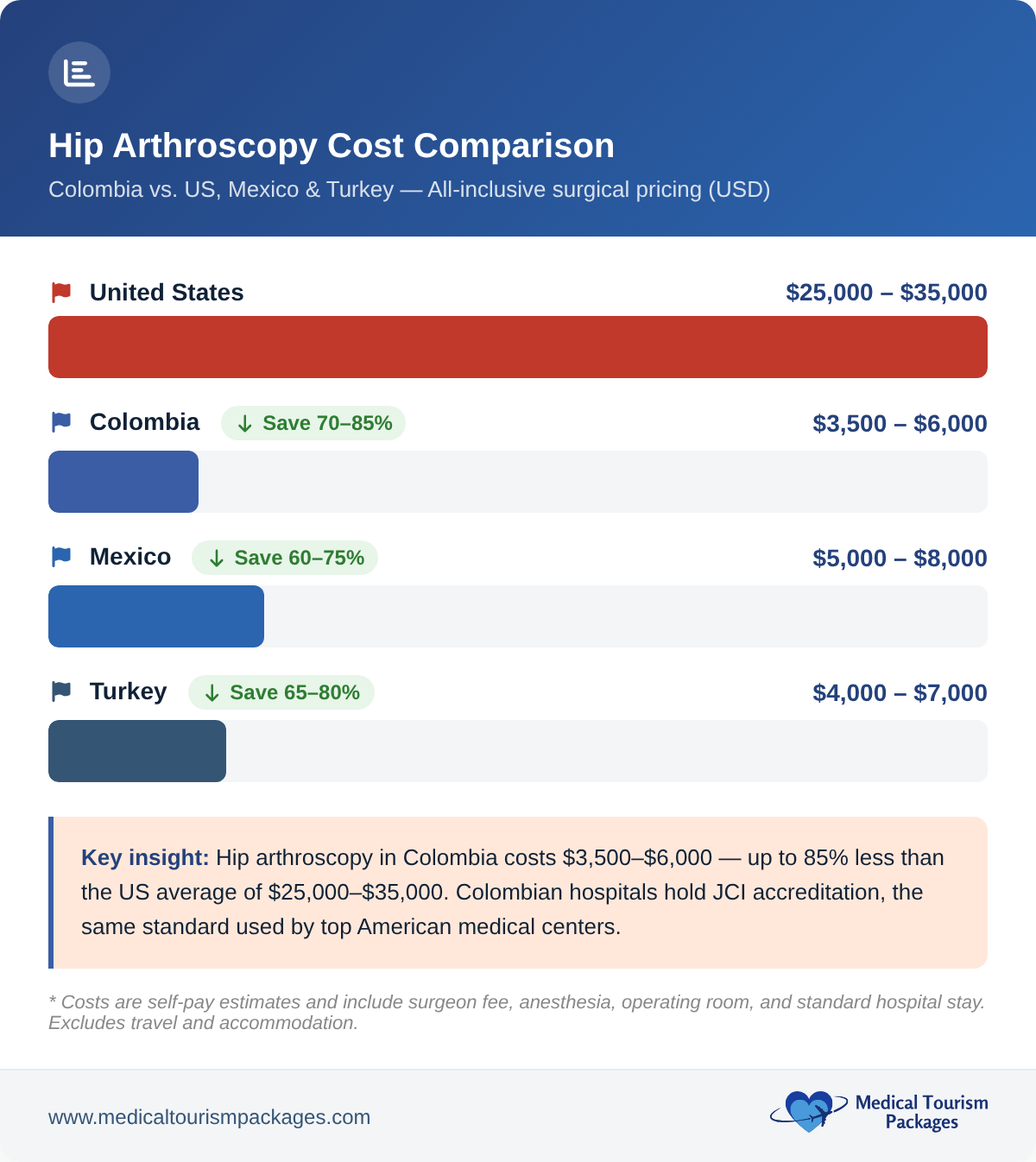
Hip arthroscopy in Colombia costs $3,500–$6,000 USD. This figure covers the surgeon’s fee, anesthesiologist, operating room, and standard hospital stay. It is 70–85% less than what the same procedure costs in the US.
How Does the Cost Compare to the US, Mexico, and Turkey?
| Destination | Estimated Cost (USD) | Approximate Savings vs. US |
|---|---|---|
| United States | $25,000 – $35,000 | — |
| Colombia | $3,500 – $6,000 | 70–85% |
| Mexico | $5,000 – $8,000 | 60–75% |
| Turkey | $4,000 – $7,000 | 65–80% |
Colombia sits at the lower end of the cost range among major medical tourism destinations. It does not sacrifice accreditation standards or surgical quality to get there.
What Additional Costs Should Patients Budget For?
The procedure cost does not cover everything. Budget an extra $2,000–$3,500 for a standard two-week stay. Specific expenses include:
- Flights — round-trip airfare from major US cities to Bogotá or Medellín runs $400–$800
- Accommodation — budget $50–$120 per night; plan for a minimum 14-night stay
- Medications — post-surgical prescriptions not included in the hospital discharge package
- Extended stay — if recovery requires more time before you are cleared to fly, add extra accommodation costs
- Crutches and mobility aids — often available locally but not always included in the surgical fee
How Do You Choose the Right Hip Arthroscopy Surgeon in Colombia?
Not every orthopedic surgeon in Colombia specializes in hip arthroscopy. It is a technically demanding procedure. The hip joint is deep, access is restricted, and the margin for error is narrow. Choosing a surgeon with specific hip arthroscopy experience — not just general orthopedic credentials — is essential.
What Credentials Should a Hip Arthroscopy Surgeon in Colombia Have?
When reviewing a surgeon’s background, look for the following:
- Fellowship training in hip preservation or sports medicine — ideally completed in the US, Europe, or at a recognized Latin American center
- Board certification in orthopedic surgery — issued by the Colombian Board of Orthopedics and Traumatology or an internationally recognized equivalent
- Privileges at a JCI-accredited hospital — confirms the surgeon operates within a facility held to international safety standards
- High annual arthroscopy volume — surgeons performing 50 or more hip arthroscopies per year have better outcomes than low-volume practitioners
- English proficiency — essential for clear communication throughout consultation, surgical planning, and follow-up
For more details on orthopedic care options, see our complete guide to orthopedic surgery in Colombia.
What Questions Should Patients Ask During a Virtual Consultation?
A virtual consultation is your chance to evaluate the surgeon directly. Come prepared with specific questions:
- How many hip arthroscopies do you perform per year?
- What is your complication rate for this procedure?
- Have you treated international patients before? How do you manage post-return follow-up?
- What does your standard rehabilitation protocol look like after hip arthroscopy?
- How long do you recommend I stay in Colombia before flying home?
- What happens if I need a revision procedure after returning home?
- Which specific repairs do you expect based on my MRI findings?
- What anesthesia approach do you use and who administers it?
- How will we communicate after I return home — and how quickly do you respond?
- Can you provide outcome data or patient references from similar cases?
A surgeon who answers these questions clearly and without hesitation shows strong experience and transparency.
What Happens During Hip Arthroscopic Surgery in Colombia?
Hospitals in Bogotá, Medellín, and Cali that perform high volumes of hip arthroscopy follow standardized protocols. These protocols align with US and European practice. Here is what to expect at each stage.
What Pre-Operative Tests Are Required Before Hip Arthroscopy?
Your surgical team will require the following before clearing you for surgery:
- Blood panel — complete blood count (CBC), clotting function, and infection markers
- MRI of the hip — the primary imaging used to confirm the diagnosis and assess the labrum, FAI morphology, and cartilage damage
- ECG — required for patients over 40 to rule out cardiac risk before general anesthesia
- Anesthesia assessment — a pre-operative review covering your medical history, allergies, and airway evaluation
- Medication review — certain medications must be paused before surgery, including blood thinners, NSAIDs, and some supplements
Most Colombian private hospitals let you complete these tests on arrival, typically one to two days before your scheduled procedure.
What Actually Happens During the Procedure?
You will be positioned on a specialized traction table. The table applies gentle distraction to the hip joint. This separates the femoral head from the acetabulum by a few millimeters. That space is needed to insert instruments safely.
The surgeon makes two or three small incisions around the hip. The arthroscope enters through the first portal. It transmits a live image to a monitor in the operating room. Surgical instruments enter through the remaining portals.
Most hip arthroscopies involve work in two compartments:
- Central compartment — the surgeon addresses the labrum and cartilage. A torn labrum is reattached using suture anchors. Damaged cartilage is smoothed during chondroplasty. Loose fragments are removed.
- Peripheral compartment — the surgeon addresses FAI. Excess bone on the femoral head (cam lesion) or acetabular rim (pincer lesion) is trimmed using an arthroscopic burr. This reshapes the joint to stop the impingement.
Once all repairs are complete, the instruments are withdrawn. The incisions are closed with sutures or surgical tape. The entire procedure takes one to two hours.
What Does Recovery in Colombia Look Like After Surgery?
Recovery follows four phases. The pace depends on the complexity of your repairs and individual healing.
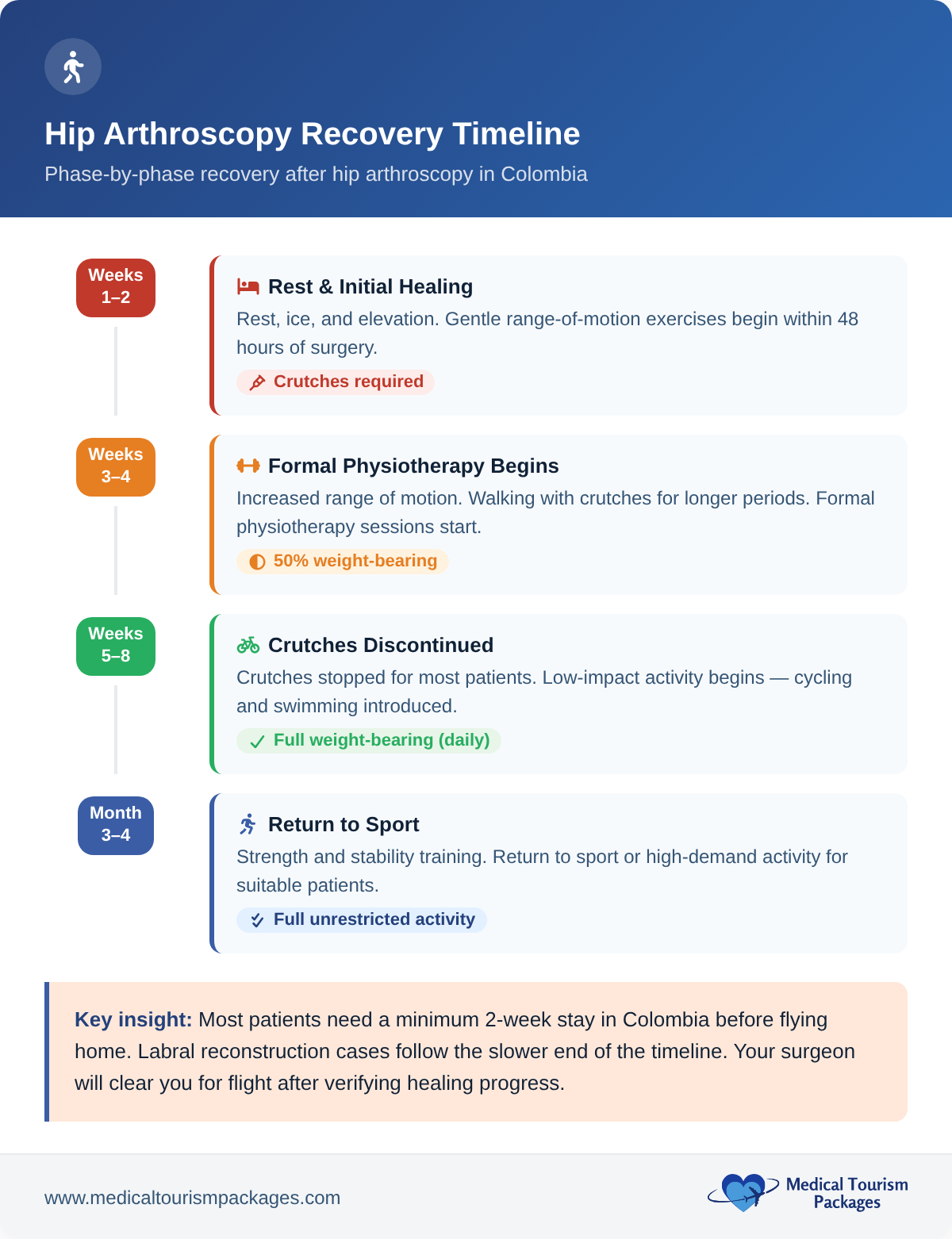
| Phase | Mobility Goals | Weight-Bearing Status |
|---|---|---|
| Week 1–2 | Rest, ice, elevation; gentle range-of-motion exercises begin within 48 hours | Toe-touch or partial weight-bearing on crutches |
| Week 3–4 | Increased range of motion; walking with crutches for longer periods; formal physiotherapy begins | Progressing to 50% weight-bearing; crutches still required |
| Week 5–8 | Crutches discontinued for most patients; low-impact movement (cycling, swimming) introduced | Full weight-bearing for daily activities |
| Month 3–4 | Strength and stability training; return to sport or high-demand activity for suitable patients | Full unrestricted weight-bearing |
Labral reconstruction cases typically follow the slower end of this timeline.
What Are the Risks of Hip Arthroscopic Surgery?
Hip arthroscopy has a strong safety profile. Complication rates at JCI-accredited Colombian hospitals match published data from major US orthopedic centers. Serious complications are uncommon. Every surgical procedure carries risk, and patients should know what to watch for.
What Complications Can Occur and How Common Are They?
The most common complications are temporary and manageable. Serious complications are rare.
| Complication | Incidence Rate | Typical Resolution |
|---|---|---|
| Traction-related nerve numbness | 1–2% | Temporary; resolves within days to weeks in most cases |
| Infection | Below 1% | Managed with antibiotics; rarely requires further intervention |
| Arthrofibrosis (joint stiffness) | ~2% | Resolves with dedicated physical therapy in most cases |
| Failed repair requiring revision | 2–3% within two years | Revision arthroscopy or alternative surgical approach |
| Fluid extravasation | Rare | Temporary swelling that resolves without intervention |
| Avascular necrosis | Very rare | Managed based on severity; may require further surgery |
What Should Patients Do If a Complication Arises After Returning Home?
Contact your Colombian surgical team first. Most JCI-accredited hospitals in Bogotá, Medellín, and Cali provide remote follow-up as a standard part of care. Your surgeon can review photos, imaging, or video consultations. They can assess whether what you are experiencing is normal recovery or something that needs intervention.
If in-person evaluation is needed, see a local orthopedic provider. Bring your full surgical report, operative notes, and post-discharge instructions. These documents should be provided by the hospital before you leave Colombia. They give any treating physician the detail they need to continue your care.
For urgent symptoms — significant swelling, fever, sudden increase in pain, or any sign of infection — seek local care immediately. Notify your Colombian surgeon at the same time. Do not wait for a remote consultation if symptoms are escalating.
Is Hip Arthroscopic Surgery in Colombia Right for You?
Colombia is a strong option for patients with a confirmed diagnosis — FAI, a labral tear, or another structural hip condition — who have already tried conservative treatment. If physical therapy and injections have not resolved your pain, and your home surgeon has recommended arthroscopy, Colombia gives you access to the same procedure at far lower cost with a much shorter wait.
The ideal candidate is generally healthy enough for general anesthesia. They have a clear diagnosis supported by MRI imaging. They can commit to a minimum two-week stay in Colombia for initial recovery. Patients without advanced arthritis or severe structural deformity get the best outcomes from hip arthroscopy regardless of where the procedure is performed.
Colombia’s key advantages are straightforward:
- JCI-accredited hospitals in Bogotá, Medellín, and Cali
- Fellowship-trained surgeons — many trained in the US or Europe
- 50–70% cost savings versus US prices
- Scheduling windows of weeks — not months
- No visa required for US and Canadian citizens for stays up to 90 days
The main considerations are also clear. You will manage post-surgical recovery away from home. Follow-up care after you return requires coordination between your Colombian surgeon and a local provider. Bogotá’s high altitude is worth discussing with your surgeon if you have any cardiopulmonary history. For more on planning your trip, see our Colombia medical tourism guide.
If your diagnosis is confirmed and the cost or wait time at home is a barrier, Colombia deserves serious consideration. Start by gathering your MRI and medical records. Identify two or three JCI-accredited hospitals in Bogotá, Medellín, or Cali. Request virtual consultations with fellowship-trained hip arthroscopy specialists. The information you need to make a confident decision is available before you book a single flight.
What Questions Do Medical Tourists Ask Most Often About Hip Arthroscopy in Colombia?
How long should I stay in Colombia after hip arthroscopy?
You should stay at least 14 days in Colombia after hip arthroscopy before flying home. Simple labral repairs may allow departure at 10–12 days. Complex reconstructions or FAI corrections require the full two weeks. Your surgeon will clear you for flight after checking your healing progress.
US and Canadian citizens do not need a visa for stays up to 90 days in Colombia.
Are Colombian hospitals accredited to international standards?
Yes, Colombia has multiple JCI-accredited hospitals. Joint Commission International (JCI) is the same standard used by top US hospitals. Accredited facilities in Bogotá, Medellín, and Cali meet identical patient safety and outcome standards as US medical centers.
You can verify any hospital’s accreditation status directly on the JCI website before booking.
Do Colombian hip arthroscopy surgeons speak English?
Yes, most specialized hip arthroscopy surgeons at JCI-accredited hospitals in Colombia are fluent in English. Many completed fellowship training in the US or Europe, where English proficiency was required. International patient coordinators also provide bilingual support throughout your care.
What happens if I have complications after returning home?
Contact your Colombian surgical team first. Most JCI-accredited hospitals in Bogotá, Medellín, and Cali provide remote follow-up as a standard part of care. Your surgeon can assess your situation through photos, imaging, or video consultations.
If in-person care is needed, see a local orthopedic provider. Bring your surgical report, operative notes, and post-discharge instructions from Colombia. For urgent symptoms — fever, sudden pain, or signs of infection — seek local care immediately and notify your Colombian surgeon at the same time.
Is it safe to fly after hip arthroscopy in Colombia?
Yes, it is safe to fly after the recommended waiting period. Most surgeons recommend a minimum 14-day stay before flying home. Cabin pressure changes and the risk of blood clots require adequate healing time before any long flight. Your surgeon will confirm you are cleared before departure.
Keep your leg elevated during the flight to reduce swelling. Follow any anticoagulation instructions your surgeon gives you for travel days.
What training do Colombian hip arthroscopy surgeons have?
Colombian hip arthroscopy surgeons are board-certified orthopedic specialists with fellowship training in hip preservation or sports medicine. They complete a six-year medical degree, followed by a four-year orthopedic surgery residency. After residency, they pursue a one to two-year fellowship focused on hip arthroscopy and joint preservation.
Fellowship training often occurs at premier centers in the United States or top-tier Latin American institutions. Many surgeons are members of the Colombian Society of Orthopedics and Traumatology and international hip preservation societies.
Ready to Start Your Hip Arthroscopy Journey in Colombia?
Medical Tourism Packages coordinates your entire hip arthroscopy journey in Colombia. We connect you with JCI-accredited hospitals in Bogotá, Medellín, and Cali, arrange your travel and accommodations, and provide bilingual support throughout your treatment. Get a free consultation to discuss your hip condition and receive a personalized quote.
Contact us today to start planning your affordable hip arthroscopy in Colombia.