Book Appointment Now


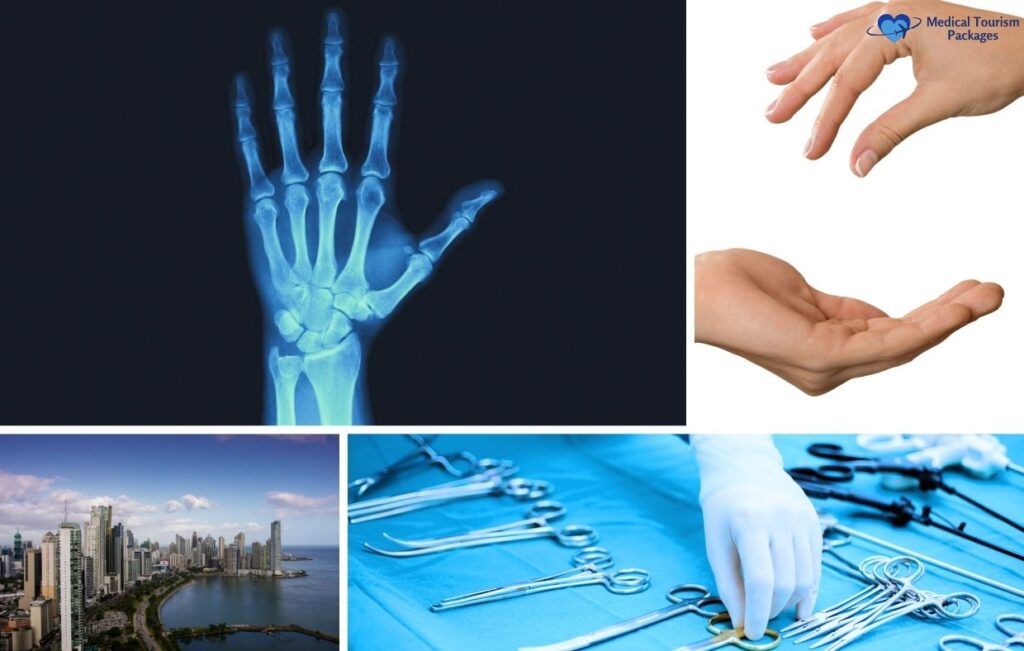
Hand Surgery in Panama: Costs, Procedures, Top Clinics, and Medical Tourism Guide
 By
By
Hand surgery in Panama delivers expert care at 50-75% lower costs than the United States, with JCI-accredited hospitals affiliated with Johns Hopkins Medicine International and fellowship-trained specialists.
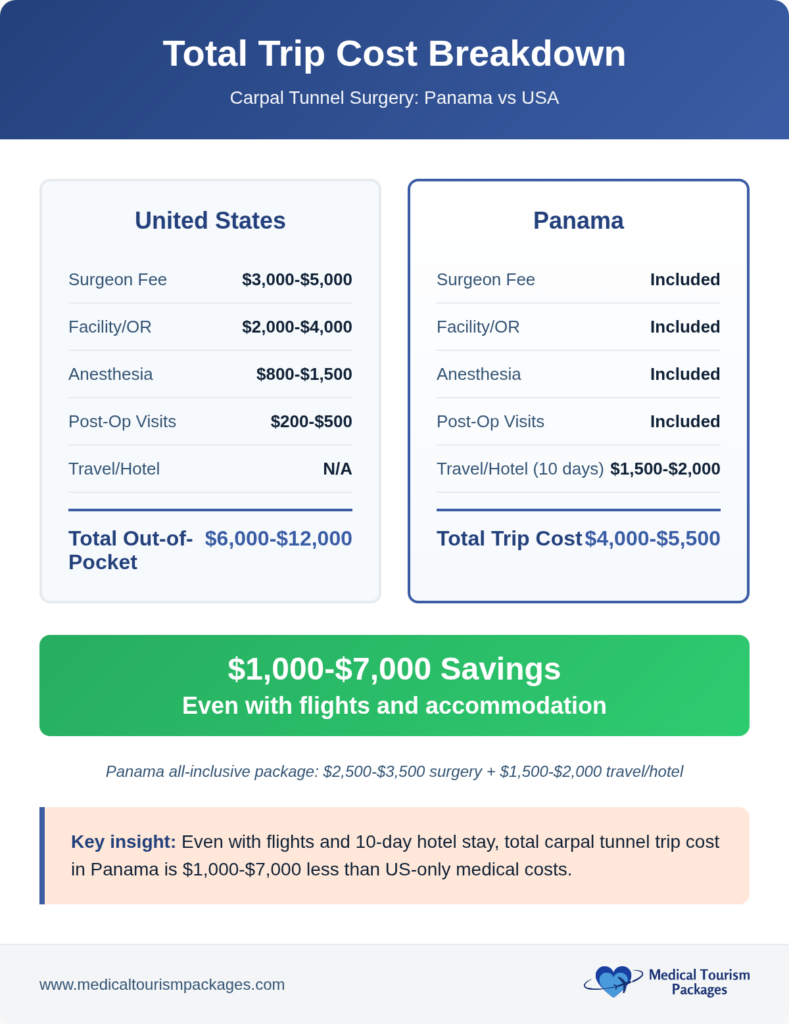
Carpal tunnel release costs $2,500-$3,500 in Panama versus $6,000-$12,000 in the US. Trigger finger repair starts at $800. JCI-accredited hospitals like Pacifica Salud and Clinica Hospital San Fernando employ board-certified hand surgeons with 11-12 years of specialized training.
Our network connects you with orthopedic specialists at JCI-accredited facilities across Panama City, including Punta Pacifica and Costa del Este locations. This guide covers procedure costs, hospital profiles, travel logistics, recovery timelines, and answers to common questions about hand surgery in Panama.
What Is Hand Surgery in Panama?
Hand surgery in Panama is a specialized medical field that treats injuries, deformities, and chronic conditions of the hand, wrist, and fingers. JCI-accredited hospitals in Panama City perform these procedures at 50-70% less than United States prices.
What Conditions Does Hand Surgery Treat?
Hand surgery treats carpal tunnel syndrome, trigger finger, fractures, tendon injuries, and nerve damage. Board-certified specialists in Panama also perform Dupuytren’s contracture release, wrist arthroscopy, and complex microsurgery for nerve and blood vessel repair.
- Carpal tunnel syndrome: Numbness, tingling, and weakness caused by median nerve compression
- Trigger finger: Locked or clicking finger joints from inflamed tendon sheaths
- Hand fractures: Broken bones in the fingers, hand, or wrist requiring fixation
- Tendon injuries: Torn or severed tendons from trauma or overuse
- Nerve damage: Loss of sensation or motor function from injury or compression
- Dupuytren’s contracture: Thickened tissue that forces fingers into a bent position
Why Is Panama a Leading Destination for Hand Surgery?
Panama is a leading destination because it combines JCI-accredited hospitals, US-trained specialists, and savings of 50-70% compared to American prices. The country uses the US dollar as its currency. This removes exchange rate risk for American and Canadian patients. Our guide for American medical tourists in Panama covers travel logistics and hospital options in detail.
Pacifica Salud (Hospital Punta Pacifica) maintains a direct affiliation with Johns Hopkins Medicine International. It was the first hospital in Latin America and the Caribbean to earn this partnership. Clinica Hospital San Fernando became the first JCI-accredited facility in Panama in 2011. Both hospitals employ board-certified orthopedic specialists with fellowship training in hand surgery.
Panama City sits just 2.5 hours from Miami by direct flight. Houston is four hours away. Flights cost $300-$550 round trip from most US cities. Medical tourists recover in modern facilities in the Punta Pacifica district. This upscale area has hotels, restaurants, and pharmacies within walking distance.
How Much Does Hand Surgery Cost in Panama?
Hand surgery costs $800-$6,500 in Panama compared to $1,500-$25,000 in the United States. Carpal tunnel release costs $2,500-$3,500 (two thousand five hundred to three thousand five hundred dollars). This represents 55-70% savings versus US prices.
What Do Common Hand Surgery Procedures Cost?
Common hand surgery procedures cost between $800 and $6,500 in Panama, representing 50-75% savings compared to equivalent US procedures:
| Procedure | Panama Cost | US Cost | Savings vs US |
|---|---|---|---|
| Carpal Tunnel Release | $2,500-$3,500 | $6,000-$12,000+ | 55-70% |
| Trigger Finger Repair | $800-$1,200 | $1,500-$4,000+ | 50-70% |
| Hand Fracture Fixation | $4,000-$6,500 | $8,000-$15,000+ | 50-65% |
| Tendon/Nerve Repair | $3,500-$6,000 | $10,000-$25,000+ | 60-75% |
How Do Panama Costs Compare to the United States and Canada?
Panama costs are 50-75% lower than US prices and 40-60% lower than Canadian private surgery fees:
| Procedure | Panama | United States | Canada (Private) |
|---|---|---|---|
| Carpal Tunnel Release | $2,500-$3,500 | $6,000-$12,000+ | $4,000-$7,000 CAD |
| Trigger Finger Repair | $800-$1,200 | $1,500-$4,000+ | $1,000-$2,500 CAD |
| Hand Fracture Fixation | $4,000-$6,500 | $8,000-$15,000+ | $6,000-$10,000 CAD |
| Tendon/Nerve Repair | $3,500-$6,000 | $10,000-$25,000+ | $7,000-$15,000 CAD |
Canadian patients face an extra advantage. Public system wait times for carpal tunnel surgery in Canada can reach 6-12 months or longer. Panama offers the same procedure within days of consultation. This eliminates months of pain and lost productivity.
What Is Included in a Hand Surgery Package?
A hand surgery package in Panama typically includes the surgeon fee, facility fees, anesthesia, pre-operative tests, and post-operative follow-up visits. Panama uses the US dollar. This means no currency conversion fees for American patients.
- Included: Surgeon fee, operating room, anesthesia, pre-op lab work, post-op visits
- Not included: Round-trip flights ($300-$550 from US cities), hotel ($80-$200 per night), meals
- Payment: Credit cards accepted at all major hospitals in Panama City
Which Hospitals Perform Hand Surgery in Panama?
The leading hospitals for hand surgery in Panama are Pacifica Salud, Clinica Hospital San Fernando, Centro Medico Paitilla, and Hospital Nacional. All are located in Panama City. Multiple facilities hold JCI accreditation.
What Makes Pacifica Salud a Top Choice for Hand Surgery?
Pacifica Salud (Hospital Punta Pacifica) is a top choice because it holds JCI accreditation and maintains a direct affiliation with Johns Hopkins Medicine International. It was the first hospital in Latin America to earn this partnership.
Pacifica Salud opened in 2006 in the Punta Pacifica district. It achieved JCI accreditation in 2011 and has maintained it since. Johns Hopkins provides consulting in clinical programs, patient safety, and quality standards. The hospital has an Advanced Orthopedic Unit with HEPA filtration operating rooms and positive pressure environments.
A second branch opened in February 2022 in Costa del Este (Town Center). This modern business district gives patients another option for consultations and follow-up care. In 2023, Pacifica Salud partnered with Global Healthcare Resources to expand its medical travel services.
What Does Clinica Hospital San Fernando Offer?
Clinica Hospital San Fernando offers JCI-accredited care with affiliations to Baptist Health South Florida, Tulane Medical Center, and Miami Children’s Hospital. It became the first JCI-accredited facility in Panama on August 3, 2011.
San Fernando has renewed its JCI accreditation four times (2014, 2017, 2020, 2023). The hospital employs over 400 physicians across all specialties. It features a dedicated Hand and Upper Extremity Rehab Unit for post-surgical recovery. This specialized unit helps patients regain strength and range of motion after hand procedures.
What Other Facilities Perform Hand Surgery in Panama?
Other facilities performing hand surgery in Panama include Centro Medico Paitilla and Hospital Nacional. The Panama Clinic building in Punta Pacifica also houses COPAC Orthopedic Center, which opened in June 2020.
| Facility | JCI Accredited | International Affiliation | Key Feature |
|---|---|---|---|
| Pacifica Salud | Yes (since 2011) | Johns Hopkins Medicine International | Advanced Orthopedic Unit |
| San Fernando | Yes (renewed 2023) | Baptist Health South Florida, Tulane | Hand & Upper Extremity Rehab |
| Centro Medico Paitilla | Yes + ISO certified | Hospiten Group (since 2018) | Operating since 1975 |
| Hospital Nacional | PAHO standards | American Hospital Mgmt Co, Kendall Medical | 100+ specialists, founded 1973 |
| The Panama Clinic (COPAC) | Yes (building level) | International standards | Mini C-arm fluoroscopy |
Centro Medico Paitilla holds both JCI accreditation and ISO certification. It joined the international Hospiten Group in February 2018. This connection gives patients access to an international hospital network with facilities in Spain, Mexico, Dominican Republic, and Jamaica.
What Types of Hand Surgery Are Available in Panama?
Hand surgery types available in Panama include carpal tunnel release, trigger finger repair, hand fracture fixation, tendon repair, nerve repair, and microsurgery. Board-certified specialists perform both open and minimally invasive techniques at JCI-accredited facilities.
What Is Carpal Tunnel Release Surgery?
Carpal tunnel release is a procedure that cuts the transverse carpal ligament to relieve pressure on the median nerve. It costs $2,500-$3,500 in Panama. Success rates reach 75-90% in long-term studies, with 93.8% of patients reporting complete numbness resolution.
Surgeons perform this procedure using either open or endoscopic techniques. Endoscopic release uses a small camera and requires a shorter incision. A large study of 855,832 carpal tunnel surgeries found complication rates under 1%. The recurrence rate is 5-10% (five to ten percent) over a patient’s lifetime.
What Is Trigger Finger Repair?
Trigger finger repair is a procedure that releases a locked or clicking finger joint. Surgeons cut the narrowed tendon sheath to restore smooth finger movement. This outpatient procedure costs $800-$1,200 in Panama versus $1,500-$4,000 in the United States.
The surgery takes about 20 minutes under local anesthesia. Most patients return to light activities within a few days. Full recovery takes four to six weeks (4-6 weeks). Trigger finger repair has one of the highest success rates among hand procedures.
What Are Hand Fracture and Tendon Repair Procedures?
Hand fracture fixation uses pins, screws, or plates to stabilize broken bones. Tendon repair reconnects torn or severed tendons. These procedures cost $3,500-$6,500 in Panama. US prices range from $8,000 to $25,000 or more for the same surgeries.
Fracture fixation uses Mini C-Arm fluoroscopy for real-time imaging during surgery. This technology lets surgeons verify bone alignment without large incisions. Tendon repair requires precise suturing techniques and careful rehabilitation. Both procedures benefit from Panama’s specialized Hand and Upper Extremity Rehab Units. Learn more about orthopedic surgery options and what to expect from these procedures.
What Is Hand Microsurgery?
Hand microsurgery is a technique that repairs tiny blood vessels, nerves, and tissues using a surgical microscope. Specialists perform nerve grafts, replantation of severed fingers, and free tissue transfers. These complex procedures require fellowship-trained surgeons.
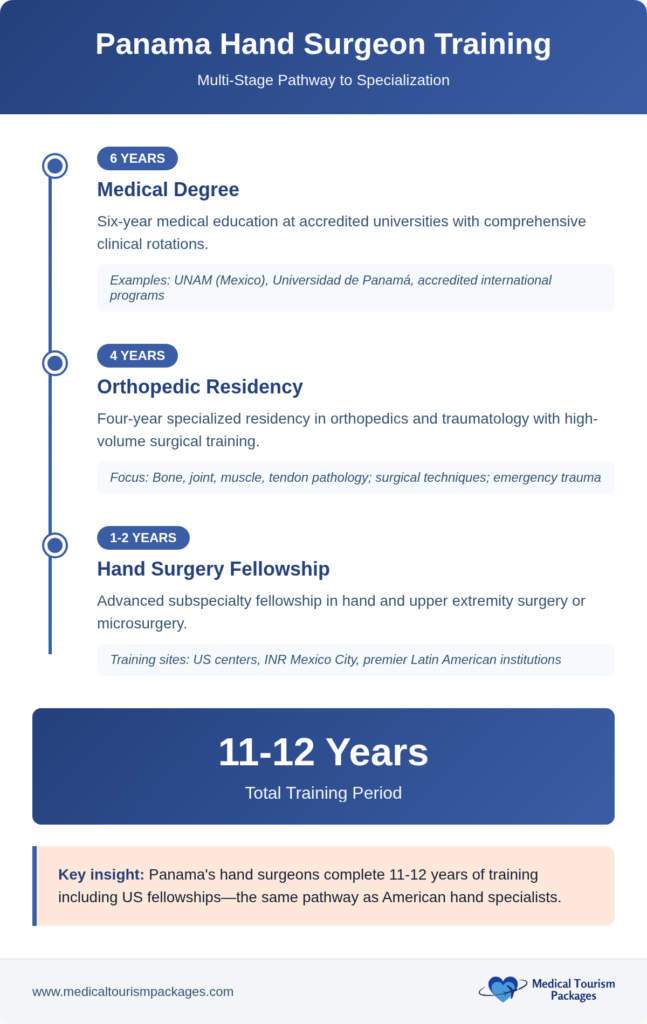
Panama’s fellowship-trained hand specialists complete 11-12 years of training. This includes six years of medical school, four years of orthopedic residency, and one to two years of hand surgery fellowship. Many complete fellowship training at US institutions or top-tier Latin American centers.
How Do You Plan Your Hand Surgery Trip to Panama?
You plan your hand surgery trip by gathering medical records, booking flights to Tocumen International Airport, and coordinating with your chosen hospital. Most patients need 7-21 days in Panama depending on their procedure. No visa is required for stays up to 180 days.
What Are the Travel and Visa Requirements?
US and Canadian citizens do not need a visa for stays up to 180 days. EU citizens can stay up to 90 days without a visa. Your passport must be valid for at least three months (3 months) beyond your travel date.
- Passport: Valid for at least 3 months beyond travel date
- Visa: Not required for US/Canada (180 days) or EU citizens (90 days)
- Proof of funds: US$500 minimum required at entry
- Return ticket: Proof of onward travel required
- Entry stamp: Confirm stamp in passport upon arrival
| Origin City | Flight Time | Round-Trip Cost | Airlines |
|---|---|---|---|
| Miami | ~2.5 hours | $300-$450 | Copa Airlines, American Airlines |
| Houston | ~4 hours | $300-$500 | United Airlines (43 flights/week) |
| New York | ~5 hours | $400-$600 | Copa Airlines, United |
| Los Angeles | ~6-7 hours | $400-$650 | Copa Airlines |
How Do You Prepare Your Medical Records?
You prepare your medical records by requesting X-rays, MRI scans, and treatment history from your current doctor. Send digital copies to your Panama hospital 7-10 days before your appointment. Bring originals to your first consultation.
- Imaging: X-rays or MRI of your hand/wrist (taken within 6 months)
- Medical history: Current medications, allergies, and prior surgeries
- Treatment records: Notes from your referring physician
- Insurance documents: Travel medical insurance proof of coverage
How Long Should You Stay in Panama After Surgery?
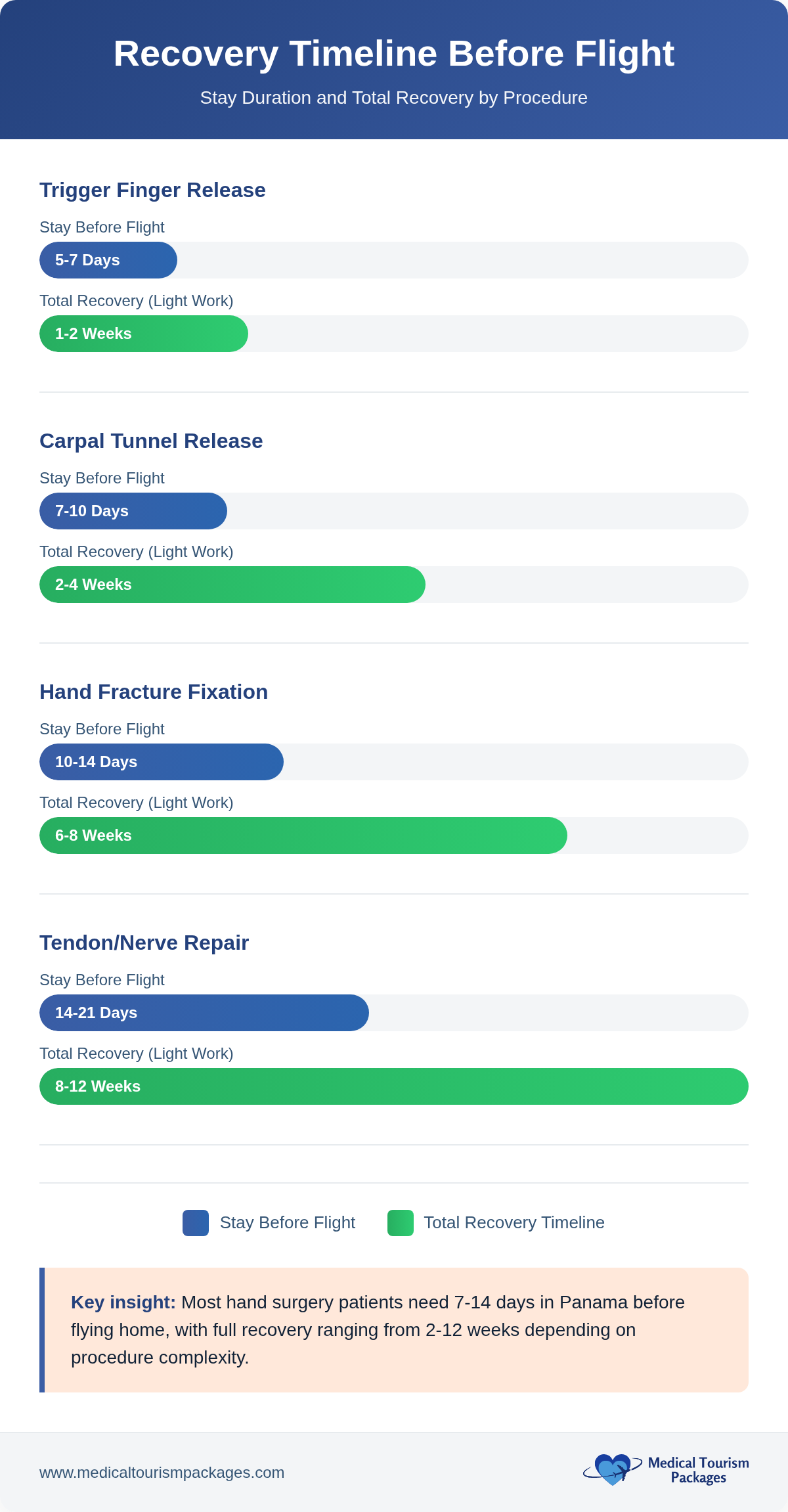
You should stay 7-21 days in Panama after hand surgery. Simple procedures like carpal tunnel release need 7-10 days. Complex procedures like tendon repair require 14-21 days (two to three weeks). Your surgeon will clear you for flight after checking your healing.
| Procedure | Minimum Stay | Recommended Stay | Full Recovery |
|---|---|---|---|
| Carpal Tunnel Release | 7 days | 10 days | 4-6 weeks |
| Trigger Finger Repair | 5 days | 7 days | 4-6 weeks |
| Hand Fracture Fixation | 10 days | 14 days | 6-8 weeks |
| Tendon/Nerve Repair | 14 days | 21 days | 8-12 weeks |
What Should You Expect During Recovery?
You should expect a structured recovery period with follow-up appointments, physical therapy, and gradual return to normal activities. Panama City offers comfortable recovery options in the Punta Pacifica and Costa del Este districts near your hospital.
What Does the Recovery Timeline Look Like?
The recovery timeline depends on your procedure. Simple carpal tunnel release patients can use their hand for light tasks within days. Complex tendon repair patients may need 8-12 weeks (eight to twelve weeks) for full recovery.
- Days 1-3: Rest, ice, elevation. Pain managed with prescribed medication
- Days 4-7: Suture check and first follow-up appointment. Light finger movement begins
- Days 7-14: Suture removal. Gentle range-of-motion exercises start
- Weeks 3-6: Physical therapy begins. Gradual return to daily activities
- Weeks 6-12: Strengthening exercises. Full activity clearance for complex procedures
What Recovery Accommodations Are Available in Panama City?
Recovery accommodations in Panama City include hotels and serviced apartments in the Punta Pacifica and Costa del Este districts. These areas are within minutes of Pacifica Salud and other major hospitals. Hotels range from $80 to $200 per night.
The Punta Pacifica district offers upscale hotels with restaurants, pharmacies, and shops within walking distance. Casco Viejo, the restored colonial district, has boutique hotels for a more cultural recovery experience. Both areas are safe and well-served by taxis and rideshare apps.
How Do You Manage Follow-Up Care After Returning Home?
You manage follow-up care by coordinating with your Panama surgeon and your home physician. Many Panama hospitals offer telemedicine follow-up appointments. Your surgeon provides a detailed report for your primary care doctor before you leave.
Pacifica Salud’s affiliation with Johns Hopkins Medicine International creates pathways for high-level consultation if complications arise. Surgeons provide direct contact information for post-operative questions. The US Embassy in Panama City (+507-317-5000) can assist with medical emergencies.
How Safe Is Hand Surgery in Panama?
Hand surgery in Panama is safe. JCI-accredited hospitals follow the same patient safety protocols used in top US medical centers. Carpal tunnel release has a complication rate below 1% based on a study of 855,832 surgeries. Success rates reach 75-90% in long-term follow-up.
What Are the Success and Complication Rates?
Success rates for carpal tunnel release reach 75-90% in long-term studies. Some studies report 96-98% (ninety-six to ninety-eight percent) initial success. Complete numbness resolution occurs in 93.8% of patients at 11-year follow-up. Complication rates stay below 1%.
These statistics come from international peer-reviewed studies, not Panama-specific data. However, Panama’s JCI-accredited hospitals follow identical protocols to US facilities. The recurrence rate for carpal tunnel syndrome is 5-10% over a patient’s lifetime. Early intervention improves outcomes.
How Does JCI Accreditation Protect Patients?
JCI (Joint Commission International) accreditation protects patients by requiring hospitals to meet the same safety and quality standards used by top American medical centers. Panama has multiple JCI-accredited facilities performing hand surgery.
JCI evaluates hospitals on patient safety, infection control, medication management, and clinical outcomes. Pacifica Salud has maintained JCI accreditation since 2011. San Fernando renewed its accreditation in 2023. Centro Medico Paitilla holds both JCI accreditation and ISO certification. MINSA (Ministry of Health) oversees all healthcare facilities in Panama.
What Are the Advantages and Disadvantages?
The main advantages are cost savings of 50-75%, JCI-accredited facilities, US-trained surgeons, and no currency exchange risk. The main disadvantages include travel distance, limited malpractice law, and separation from your home support network during recovery.
Advantages:
- 50-75% savings on hand surgery procedures
- Multiple JCI-accredited hospitals with international affiliations
- US dollar economy removes exchange rate risk
- Short flights from major US cities (2.5-5 hours)
- No visa required for US and Canadian citizens (up to 180 days)
- English-speaking specialists and patient coordinators
- No wait times compared to Canadian public system (6-12+ months)
- Patients considering alternatives may also explore hand surgery in Colombia, where carpal tunnel release costs $1,750-$5,025
Disadvantages:
- Travel required during recovery period
- Panama lacks specialized medical malpractice legislation (Civil Code applies)
- Follow-up care requires coordination between Panama and home physicians
- Proposed malpractice reform (Anteproyecto de Ley N. 69) remains pending
- Law 68 (2003) provides patient rights for informed consent and confidentiality
Frequently Asked Questions About Hand Surgery in Panama
How long should I stay in Panama after hand surgery?
You should stay 7-14 days after hand surgery before flying home. Simple procedures like carpal tunnel release need 7-10 days. Complex procedures like tendon repair need 14-21 days. This allows suture removal and initial healing before flight. US and Canadian citizens can stay up to 180 days without a visa. EU citizens can stay up to 90 days.
Are Panama hospitals accredited to international standards?
Yes, Panama has multiple JCI-accredited hospitals. Joint Commission International (JCI) is the same standard used by top US hospitals. Pacifica Salud maintains a direct affiliation with Johns Hopkins Medicine International. Hospital San Fernando was the first JCI-accredited facility in Panama. Centro Medico Paitilla holds both JCI accreditation and ISO certification.
Do Panama hand surgeons speak English?
Yes, most specialized hand surgeons in Panama are fluent in English. Many completed fellowship training in the United States. International patient coordinators at JCI-accredited hospitals communicate in English throughout your treatment journey. This removes the language barriers that complicate medical tourism in many other countries.
What happens if I have complications after returning home?
Panama’s leading hospitals coordinate with your home physician for seamless post-operative follow-up. Pacifica Salud’s affiliation with Johns Hopkins Medicine International creates pathways for high-level consultation in rare cases. Many surgical packages include telemedicine follow-up appointments. You can contact your surgeon directly for any post-operative concerns.
Is it safe to fly after hand surgery?
Yes, it is safe to fly after the recommended waiting period. Surgeons recommend a 7-14 day stay before flying home. Cabin pressure changes and blood clot risks require adequate healing time before flight. Your surgeon will clear you for flight after verifying your healing progress. Keep your hand elevated during the flight to reduce swelling.
What training do Panama hand surgeons have?
Panama hand surgeons are board-certified specialists with extensive fellowship training. They complete a six-year medical degree followed by a four-year orthopedic residency. After residency, they pursue a one to two-year fellowship in hand and upper extremity surgery. Fellowship training often occurs at US institutions or top-tier Latin American centers. They are members of APOT (Panamanian Association of Orthopedics and Traumatology).
How much does carpal tunnel surgery cost in Panama compared to the US?
Carpal tunnel release costs $2,500-$3,500 in Panama compared to $6,000-$12,000 in the United States. This represents 55-70% savings. The median US cost is $7,680 from hospital chargemaster data. Panama packages include surgeon fees, facility costs, anesthesia, and post-operative follow-up visits. Panama uses the US dollar, so there are no exchange rate fees.
How long are Canadian wait times for hand surgery compared to Panama?
Canadian public system wait times for carpal tunnel surgery can reach 6-12 months or longer. Panama offers the same procedure within days of your initial consultation. Canadian citizens do not need a visa for stays up to 180 days. This eliminates months of pain, numbness, and lost productivity while waiting for publicly funded surgery.
Ready to Start Your Hand Surgery Journey in Panama?
Medical Tourism Packages coordinates your entire hand surgery journey in Panama. We connect you with JCI-accredited hospitals, arrange your travel and accommodations, and provide bilingual support throughout your treatment. Get a free consultation to discuss your hand condition and receive a personalized quote.
Contact us today to start planning your affordable hand surgery in Panama.