Book Appointment Now



Foot & Ankle Surgery in Panama: Costs, Surgeons, Hospitals, and Medical Tourist Guide
 By
By
Foot and ankle surgery in Panama costs 65–71% less than in the US at JCI-accredited hospitals with fellowship-trained surgeons.
A bunionectomy costs $3,500 versus $12,000 in the US. Ankle replacement runs $14,000 versus $45,000. Panama uses the US dollar, so the price quoted before surgery is the price you pay. Hospitals operate under Johns Hopkins Medicine International and Mayo Clinic Care Network affiliations.
Our network connects you with board-certified orthopedic surgeons across Panama City’s top private hospitals—each verified for JCI accreditation, FDA-approved implants, and US or European fellowship training. Below, you will find procedure costs, hospital profiles, surgeon credentials, trip planning steps, and recovery guidance.
Why Do Patients Travel to Panama for Foot & Ankle Surgery?
Latin America’s medical tourism market is projected to reach $41.3 billion by 2032. Panama sits at the center of that growth. It is not the cheapest option in the region. It is the highest-certainty option for North American and European patients. These are patients who need a serious orthopedic procedure but cannot justify domestic prices. The infrastructure, the affiliations, and the pricing are all designed with that patient in mind.
How Does Panama’s Orthopedic Care Compare to the United States?
The surgical experience in Panama is very close to what a patient would receive in a U.S. hospital. The table below breaks down the key dimensions of that comparison.
| Dimension | Panama | United States |
|---|---|---|
| Surgeon Training | U.S. / EU fellowship trained | U.S. residency and fellowship |
| Implant Brands | Stryker, Zimmer Biomet, DePuy Synthes (FDA-approved) | Stryker, Zimmer Biomet, DePuy Synthes |
| Surgical Technology | HUGO RAS, ROSA robotic platforms | Varies; many community hospitals lag behind |
| Post-Op Continuity | Lead surgeon manages care throughout | Often handed off to residents or PAs post-procedure |
The robotic technology point is worth noting. Panama has adopted platforms like the HUGO RAS and ROSA systems ahead of many mid-sized U.S. community hospitals. For high-complexity procedures, that technology gap currently favors Panama. The lead-surgeon continuity model is also significant. In the U.S., post-operative care is often transferred to physician assistants or residents after surgery. In Panama, the operating surgeon remains the primary point of contact from consultation through discharge.
For a broader view of healthcare standards and logistics, read our complete guide for American medical tourists in Panama for more planning tips.
What Foot & Ankle Procedures Are Available in Panama?
Panama’s specialist centers handle the full range of foot and ankle conditions. These range from straightforward forefoot corrections to complex reconstructive surgery. Care is concentrated in Panama City. Dedicated orthopedic centers there operate within JCI-accredited hospitals. They cover both degenerative and traumatic conditions.
Which Procedures Are Most Commonly Performed on Foreign Patients?
The procedures below are the most common ones international patients seek in Panama. Recovery timelines and success rates match those at leading Western centers.
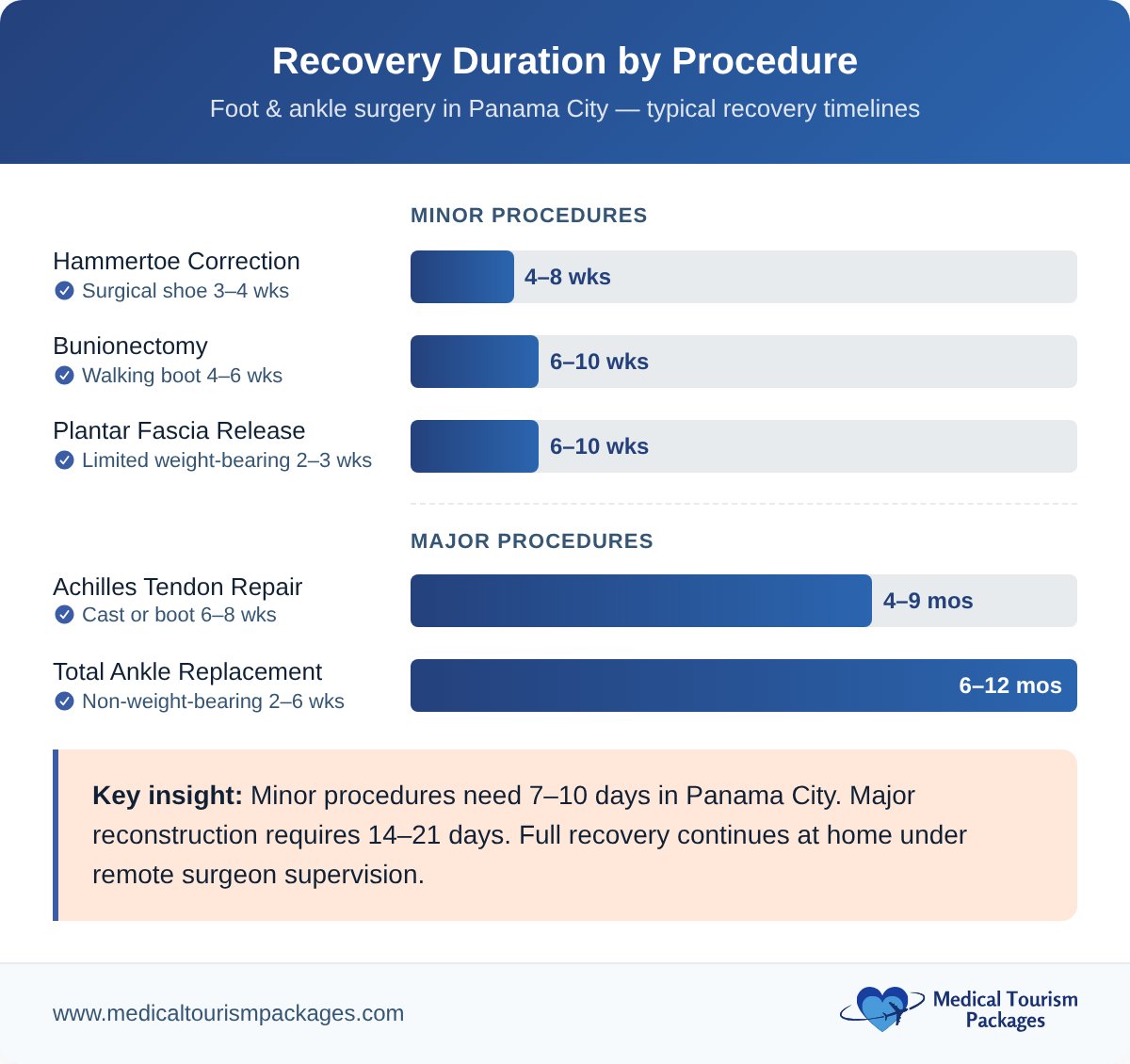
| Procedure | Recovery Timeline | Success Rate | Primary Post-Op Restriction |
|---|---|---|---|
| Bunionectomy | 6–10 weeks | 85–90% | Walking boot 4–6 weeks |
| Ankle Replacement | 6–12 months | 89% (10-yr survivorship) | Non-weight-bearing 2–6 weeks |
| Ankle Arthroscopy | 4–8 weeks | 90% | Activity restriction 2 weeks |
| Achilles Repair | 4–9 months | 85% | Cast or boot 6–8 weeks |
| Flatfoot Reconstruction | 6–12 months | 80–85% | Non-weight-bearing 6–8 weeks |
| Hammertoe Correction | 4–8 weeks | 85–90% | Surgical shoe 3–4 weeks |
| Plantar Fascia Release | 6–10 weeks | 85–90% | Limited weight-bearing 2–3 weeks |
Are Minimally Invasive and Arthroscopic Techniques Available?
Yes, Panama’s top surgical centers perform both minimally invasive surgery (MIS) and arthroscopic procedures as standard practice. MIS bunionectomy uses specialized rotary burrs through small incisions. This means less soft tissue damage, less swelling, and faster initial healing compared to open surgery. Ankle arthroscopy uses high-definition fiber-optic cameras inserted through small portals. Surgeons use these to address anterior impingement, remove loose bodies, and treat cartilage lesions with precision. Post-operative pain is much lower than with open surgery. The success rates in the table above reflect two key practices. First, strict adherence to non-weight-bearing protocols in early recovery. Second, structured high-intensity physical therapy during mid-to-late recovery.
How Much Does Foot & Ankle Surgery Cost in Panama?
Panama’s all-inclusive pricing covers the surgeon fee, anesthesia, facility charges, and initial post-op medications. There is no unbundling of costs after the procedure. In the US, patients often receive separate bills from the surgeon, the anesthesiologist, and the facility. Panama’s single-invoice model removes that confusion.
How Do Panama’s Procedure Costs Compare to the U.S., Canada, and the UK?
The savings across all major procedures range from 65% to 71% compared to U.S. prices.
| Procedure | Panama | USA | Canada | UK | Savings vs. USA |
|---|---|---|---|---|---|
| Bunionectomy | $3,500 | $12,000 | $6,500 | $7,800 | 71% |
| Ankle Replacement | $14,000 | $45,000 | $22,000 | $31,000 | 69% |
| Achilles Repair | $4,500 | $15,000 | $10,000 | $9,500 | 70% |
| Ankle Arthroscopy | $4,500 | $13,000 | $8,500 | $8,000 | 65% |
| Flatfoot Reconstruction | $9,000 | $28,000 | $15,000 | $18,000 | 68% |
| Hammertoe Correction | $2,200 | $7,500 | $5,000 | $5,500 | 71% |
| Plantar Fascia Release | $3,000 | $9,500 | $5,500 | $6,200 | 68% |
What Does the All-In Cost Look Like for a Medical Tourist?
The savings hold up even after flights and accommodation are added. Using Flatfoot Reconstruction as an example, the fully itemized all-in cost for a medical tourist looks like this:
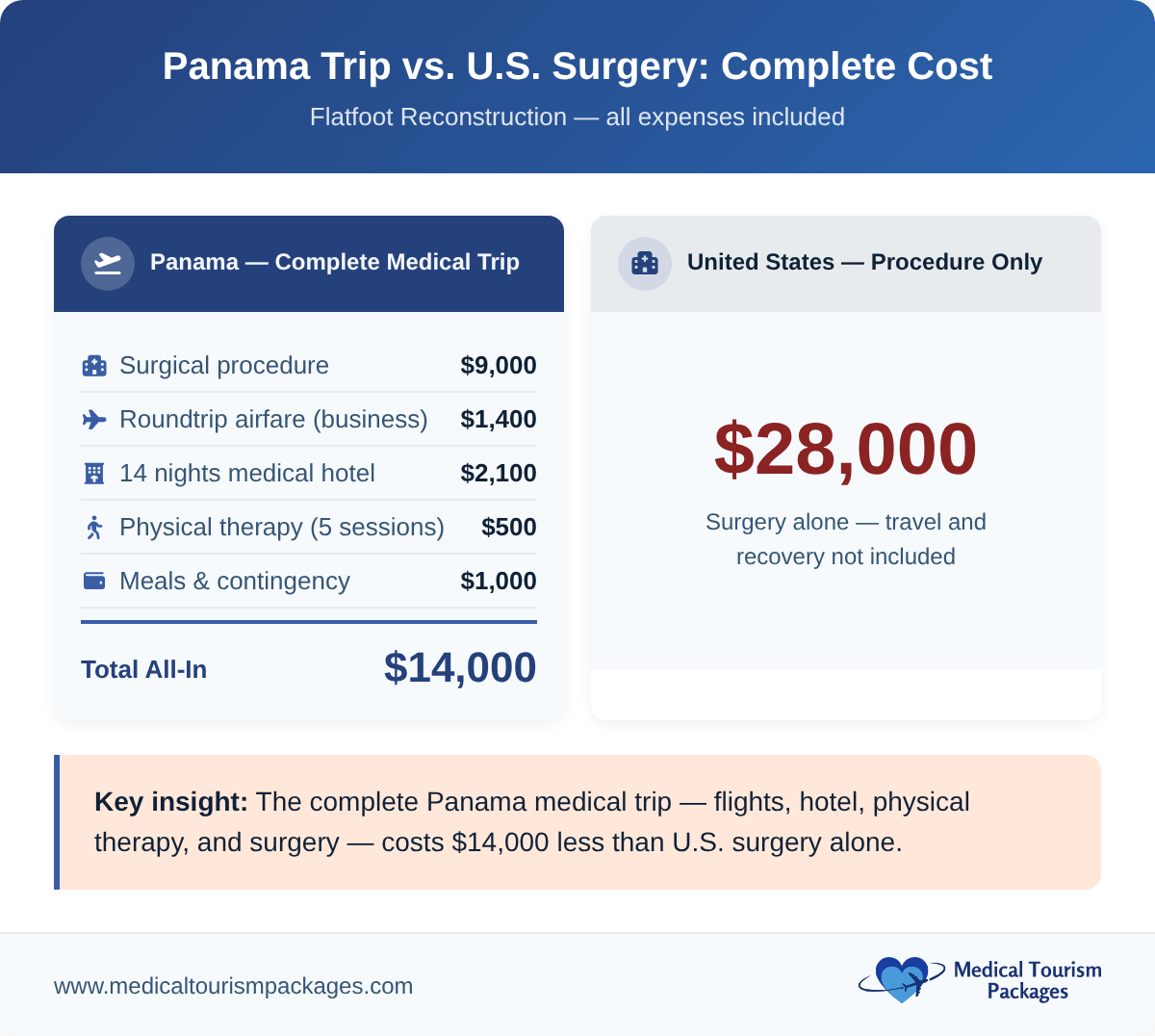
- Surgical procedure: $9,000
- Roundtrip airfare (business class): $1,400
- 14 nights medical hotel: $2,100
- 5 physical therapy sessions: $500
- Contingency and meals: $1,000
- Total all-in: $14,000
The procedure-only cost for the same surgery in the U.S. is $28,000. The complete Panama trip—including travel, lodging, and rehabilitation—costs $14,000 less than US surgery alone. That margin gives patients room to upgrade their recovery. A private nursing aide or superior recovery suite can be added. The total still comes in well below the U.S. baseline.
Which Hospitals and Surgeons in Panama Perform Foot & Ankle Surgery?
Panama City’s private hospital network is small but highly concentrated. A handful of institutions handle the majority of international orthopedic cases. Each carries credentials that are easy to verify before booking.
Is Hospital Punta Pacífica a Reliable Choice for Orthopedic Surgery?
Hospital Punta Pacífica is widely regarded as the most technically advanced private hospital in Latin America. It was the first hospital in the region to receive JCI accreditation, achieving that standard in 2011. It operates under an affiliation with Johns Hopkins Medicine International. This means clinical protocols and quality oversight are tied directly to one of the top medical institutions in the world. For foot and ankle patients, the facility uses 3 Tesla MRI for preoperative planning. This supports precise surgical mapping before a patient enters the operating room. The facility’s fellowship-trained foot and ankle surgeons manage a high volume of international orthopedic cases.
What Other Accredited Facilities Specialize in Foot and Ankle Procedures?
Beyond Punta Pacífica, three other major facilities in Panama City handle international foot and ankle cases. Each has distinct affiliations and specialist teams.
| Facility | Accreditation | Key Affiliation | Specialty Focus |
|---|---|---|---|
| The Panama Clinic | TEMOS | Mayo Clinic Care Network | COPAC foot and ankle subspecialists |
| Hospital San Fernando | JCI | Tulane University / Baptist Health | General orthopedic staff |
| Hospital Paitilla | ISO 9001 | Cleveland Clinic | COPAC-affiliated podiatry specialists |
The Panama Clinic deserves special attention for foot and ankle patients. It houses the COPAC Orthopedic Center. This is a subspecialist group focused on foot, ankle, and sports traumatology. The facility sits within a 27-story complex. That complex includes a Marriott Residence Inn connected via an indoor corridor. The hotel is built for medical tourist recovery.
For guidance on selecting the right facility for your procedure, see our overview of orthopedic surgeries available in Latin America.
How Can a Patient Verify a Surgeon’s Credentials Before Traveling?
You can verify credentials easily when you know what to ask for. Before committing to any surgeon or facility in Panama City, confirm each of the following:
- Surgeon completed a fellowship in the U.S. or Europe
- Facility holds JCI or TEMOS accreditation
- FDA-approved implants are used (Stryker, Zimmer Biomet, or DePuy Synthes)
- A fixed-price itemized quote has been provided in writing
- A digital record transfer protocol to the home physician is in place
How Do Patients Plan a Foot & Ankle Surgery Trip to Panama?
Planning a surgical trip to Panama is a structured process. The hospitals that handle international patients have refined it over many years. Each step follows a clear sequence. It begins well before the patient boards a flight.
How Does the Remote Consultation and Booking Process Work?
The process starts before the patient leaves home. Major facilities like Pacífica Salud and COPAC operate secure international patient portals. The patient uploads current imaging—MRI and X-rays—along with medical history and recent lab work. The surgical team reviews everything before any call takes place. A video consultation is then scheduled directly with the lead surgeon. This is the operating surgeon who will perform the procedure. They review the pathology, explain the proposed technique, discuss risks, and answer questions. After the consultation, the patient receives a fixed-price itemized treatment plan in writing. The quote is binding.
How Long Should Patients Plan to Stay in Panama?
Length of stay depends on the complexity of the procedure. On arrival at Tocumen International Airport (PTY), hospital-arranged transport takes the patient directly to the facility. An in-person pre-operative consultation with final blood work takes place within 24 to 48 hours of arrival.
- Minor procedures (Bunionectomy, Hammertoe Correction): 7 to 10 days
- Major procedures (Total Ankle Replacement, Flatfoot Reconstruction): 14 to 21 days
How Is Follow-Up Care Handled After Returning Home?
Continuity of care is built into the process from the start. Before discharge, the patient receives a complete digital medical record. This includes operative notes, imaging, discharge instructions, and post-op protocols. It is formatted for handoff to the patient’s home physician. The Panamanian surgeon then conducts remote video check-ins at 6 weeks, 3 months, and 6 months after surgery. At each interval, the patient obtains X-rays locally and shares the images digitally. The surgeon reviews them on the call and adjusts the rehabilitation plan.
What Is the Recovery Experience Like in Panama?
Recovery from foot and ankle surgery requires a specific physical environment. The patient is typically non-weight-bearing and needs immediate access to clinical support. Panama City has developed accommodation options built specifically around that situation. This is one of the practical advantages it holds over other medical tourism destinations.
Which Accommodations Suit Post-Surgical Patients With Limited Mobility?
Each of the three main recovery options in Panama City suits a different stage or type of patient:
- Marriott Residence Inn (Pacific Center) — The primary choice for patients at The Panama Clinic. It connects directly to the clinic via a secure indoor corridor. No outdoor navigation is required. Rooms include kitchenettes, grab bars in bathrooms, and space for a knee scooter or wheelchair.
- Marriott Executive Apartments (banking district) — Full apartment layouts that work well for patients with a family member during a 3-week recovery.
- Casco Viejo boutique hotels — Good for later-stage recovery when mobility is improving. Confirm ground-floor access or elevator availability before booking. The cobblestone streets in the historic district are not suitable for crutches or scooters in early recovery.
What Does Rehabilitation Look Like for Foreign Patients?
Rehabilitation is overseen by specialist physical therapists who coordinate directly with the surgical team throughout recovery. The protocol is divided into three structured phases, each with a distinct clinical focus.
| Phase | Timeframe | Focus Areas |
|---|---|---|
| Initial | Weeks 1–2 | Pain management, edema reduction (RICE protocol), non-weight-bearing mobility education |
| Transition | Weeks 3–6 | Partial weight-bearing in protective boot, gentle range of motion, isometric calf and foot strengthening |
| Functional | Weeks 6–12 | Full weight-bearing, boot weaned off, proprioception and balance training to prevent stiffness and atrophy |
Patients who complete the initial and transition phases in Panama are in a much better position to continue rehabilitation locally. The surgical team provides the treating therapist at home with the full protocol before discharge.
How Does Panama Compare to Other Medical Tourism Destinations?
Panama is not the only option in Latin America. Costa Rica, Mexico, and Colombia all attract orthopedic patients from North America. Each destination has a different value profile. The right choice depends on what the patient prioritizes. An honest comparison makes that decision easier.
How Does Panama Rank Against Costa Rica, Colombia, and Mexico?
Across the six dimensions that matter most to a medical tourist, Panama leads on factors most relevant to a serious orthopedic procedure.
| Dimension | Panama | Costa Rica | Mexico | Colombia |
|---|---|---|---|---|
| Cost Efficiency | Moderate (40–70% savings) | Moderate (50–70% savings) | High (60–80% savings) | Highest (65–85% savings) |
| Accreditation Intensity | Very High (Johns Hopkins / Mayo) | Moderate (JCI) | High (Multiple JCI) | Highest (Most JCI hospitals) |
| Surgeon Training Profile | Heavily U.S. / EU Trained | Balanced U.S. / Europe | Heavily U.S. Focused | Strong Local Academic Focus |
| Language Accessibility | Highest (90%+ Surgeons Bilingual) | High (Widespread English) | Varies by Region | Moderate (Spanish Dominant) |
| Recovery Infrastructure | High (Integrated Medical Hotels) | Highest (Wellness Resorts) | High (Patient Proximity) | Moderate (Urban Focus) |
| Proximity to North America | High (Copa Hub, Direct Flights) | High (Direct Flights) | Highest (Land / Short Flight) | Moderate (South American Hub) |
Mexico and Colombia offer deeper discounts. But Panama leads on accreditation, language access, and the clinical familiarity of a Johns Hopkins or Mayo-affiliated environment. For a patient managing a serious orthopedic procedure from abroad, those factors carry more weight than the price difference.
What Do Patients Say About Their Experience in Panama?
Verified patient feedback is consistently positive on the care delivery side. The most frequently cited strength is the concierge model. International patient coordinators handle logistics end to end—from airport pickup and pharmacy runs to hotel transfers and appointment scheduling. Patients describe feeling like guests rather than cases moving through a system. Facility quality is regularly compared to high-end suburban American clinics. One recurring concern appears in patient forums. Some patients find that their U.S. home doctor is reluctant to manage complications from a surgery performed abroad. This is a known issue in medical tourism generally. It reinforces the importance of choosing a JCI-accredited surgeon who provides complete operative documentation for seamless handoff.
Is Foot & Ankle Surgery in Panama the Right Choice?
Panama is not the cheapest place to have foot or ankle surgery in Latin America. Mexico and Colombia often come in lower on price. What Panama offers instead is the highest certainty of outcome for North American and European patients. It is backed by JCI accreditation, Johns Hopkins and Mayo Clinic protocols, and FDA-approved implants identical to those used domestically. For patients deciding on a serious orthopedic procedure, that distinction matters more than the last few percentage points of savings.
Who Is the Best Candidate for This Type of Medical Trip?
Three patient profiles are the best fit for foot and ankle surgery in Panama City:
- Patients facing high domestic out-of-pocket costs — If a bunionectomy costs $12,000 in the U.S. and the patient carries a high-deductible plan, Panama’s $3,500 all-inclusive price is a clear financial decision.
- Patients on long public system wait lists — Primarily in Canada and the UK, where a 12 to 18 month wait for an elective ankle procedure has real consequences for daily mobility. Panama can typically schedule within weeks.
- Patients pursuing high-complexity procedures — Procedures like Total Ankle Replacement or Flatfoot Reconstruction require high implant quality, surgical experience, and post-operative infrastructure. Panama’s specialist centers are built to handle all three.
What Should Every Patient Confirm Before Booking?
Before committing to any facility or surgeon, confirm each item on this checklist:
- Surgeon completed a U.S. or European fellowship in orthopedics or foot and ankle surgery
- Facility holds JCI or TEMOS accreditation
- FDA-approved implants (Stryker, Zimmer Biomet, or DePuy Synthes) are being used
- A fixed-price itemized quote has been provided in writing
- A digital record transfer protocol to the home physician is agreed upon
- Remote follow-up schedule confirmed at 6 weeks, 3 months, and 6 months post-surgery
The infrastructure is in place. The credentials are verifiable. The work is in knowing what to ask before the flight is booked.
What Questions Do Medical Tourists Ask Most Often About Foot & Ankle Surgery in Panama?
How long should I stay in Panama after foot or ankle surgery?
You should stay 7 to 10 days for minor procedures like bunionectomy or hammertoe correction. Major procedures like total ankle replacement or flatfoot reconstruction require 14 to 21 days. This allows for initial healing and a pre-flight clearance from your surgeon. US and Canadian citizens do not need a visa for stays up to 180 days.
Are Panama hospitals accredited to international standards?
Yes, Panama has multiple hospitals accredited to international standards. Hospital Punta Pacífica holds JCI accreditation and an affiliation with Johns Hopkins Medicine International. Hospital San Fernando also holds JCI accreditation. The Panama Clinic holds TEMOS accreditation and is part of the Mayo Clinic Care Network. These standards match the patient safety requirements of top US medical centers.
Do Panama foot and ankle surgeons speak English?
Yes, over 90% of specialized orthopedic surgeons at Panama City’s top private hospitals are fluent in English. Most completed fellowships in the United States or Europe. International patient coordinators also communicate clearly throughout your treatment journey. This removes the language barriers common in other medical tourism destinations.
What happens if I have complications after returning home?
Panama’s leading foot and ankle surgeons provide a complete digital medical record before you leave. This includes operative notes, imaging, and post-op protocols formatted for your home physician. Your Panamanian surgeon conducts remote video check-ins at 6 weeks, 3 months, and 6 months after surgery. You can contact your surgeon directly for any post-operative concerns. Johns Hopkins and Mayo Clinic affiliations create pathways for high-level consultation in rare cases.
Is it safe to fly home after foot or ankle surgery in Panama?
Yes, it is safe to fly after the recommended waiting period. Surgeons recommend staying 7 to 10 days for minor procedures before flying. Major procedures require 14 to 21 days. This waiting period reduces the risk of blood clots and allows initial healing before cabin pressure changes. Your surgeon will clear you for flight after checking your healing progress. Keep your foot elevated during the flight to reduce swelling.
What training do Panama foot and ankle surgeons have?
Panama foot and ankle surgeons are board-certified orthopedic specialists with fellowship training. They complete a six-year medical degree followed by a four-year orthopedic residency. After residency, they pursue a one to two-year fellowship in foot, ankle, or sports surgery. Fellowship training often occurs at top centers in the United States or Europe. Many surgeons are members of professional associations including COPAC (Panama’s orthopedic specialty group).
Ready to Start Your Foot & Ankle Surgery Journey in Panama?
Medical Tourism Packages coordinates your entire foot and ankle surgery journey in Panama. We connect you with JCI-accredited hospitals, arrange your travel and accommodations, and provide bilingual support throughout your treatment. Get a free consultation to discuss your orthopedic health goals and receive a personalized quote.
Contact us today to start planning your affordable foot and ankle surgery in Panama.