Book Appointment Now

Carpal Tunnel Surgery in Colombia: Costs, Top Hospitals, and Recovery Guide
 By
By
Carpal tunnel surgery in Colombia costs $1,750–$3,650 — 70% less than US prices — performed by fellowship-trained surgeons at JCI hospitals.
Carpal tunnel release in Colombia ranges from $1,750 to $3,650 at JCI-accredited facilities. The same procedure costs $5,800 to $11,700 in the United States. Colombia ranks third in the world for medical tourism, with hospitals holding the same accreditation as top US centers.
Our network connects you with fellowship-trained hand surgeons across Bogotá, Medellín, and Cali — each verified for ASOCIMANO credentials, JCI hospital accreditation, and patient outcomes. Below, you’ll find procedure types, cost comparisons, hospital profiles, safety data, and everything you need to plan your surgery.
What Is Carpal Tunnel Syndrome and When Is Surgery Needed?
Carpal tunnel syndrome (CTS) is the most common nerve compression condition in the upper limb. It affects millions of people worldwide. It is one of the most frequently performed hand surgeries in Colombia.
What Happens Inside the Carpal Tunnel?
The carpal tunnel is a narrow passage at the base of your palm. Eight small carpal bones form the floor and sides. The transverse carpal ligament forms the roof. Running through this tunnel are ten structures — the median nerve, plus nine flexor tendons that control finger movement.
When pressure builds inside the tunnel, the median nerve gets compressed. Normal pressure inside the tunnel is 2 to 10 mmHg. In CTS patients, that pressure can rise above 30 mmHg during wrist movement. When canal pressure exceeds the pressure in surrounding capillaries, blood flow to the nerve stops.
The result is the classic CTS symptom pattern: tingling and numbness in the thumb, index, and middle fingers. Pain wakes you at night. In advanced cases, you lose strength in the thenar muscles at the base of the thumb. The longer the nerve stays compressed, the slower the recovery — which is why timing your surgery matters.
How Is CTS Diagnosed?
Colombian hand surgeons diagnose CTS using two primary tools.
The first is the CTS-6 clinical scoring tool. This is recommended by the 2024 American Academy of Orthopaedic Surgeons (AAOS) guidelines. It checks symptom pattern, night symptoms, and physical findings without advanced imaging.
The second is electrodiagnostic testing — nerve conduction velocity (NCV) and electromyography (EMG). These studies measure how well the median nerve conducts electrical signals. They confirm the diagnosis and classify severity as mild, moderate, or severe. Colombian centers use this grading to guide surgical planning and set realistic recovery expectations.
MRI is not recommended for routine CTS diagnosis per current AAOS guidelines.
What Conservative Treatments Should You Try First?
Surgery is indicated when conservative treatment has failed. Most surgeons require three to six months of non-surgical management before recommending an operation. Standard conservative options include:
- Night splinting — a wrist brace worn during sleep holds the wrist in a neutral position and relieves nocturnal pressure on the median nerve
- Corticosteroid injection — a steroid injected into the carpal tunnel reduces inflammation and provides temporary symptom relief
- Occupational therapy and activity modification — ergonomic adjustments and exercises reduce repetitive strain contributing to nerve compression
If symptoms persist or worsen after this period — or if nerve conduction studies show severe compression — surgery becomes the appropriate next step.
What Surgical Approaches Are Available in Colombia?
Colombia’s top hand surgery centers offer three surgical approaches for carpal tunnel release. All three share the same goal — dividing the transverse carpal ligament to decompress the median nerve. They differ in technique, recovery speed, and which patients they suit best.
How Do Open Release, Endoscopic Release, and TCTR Compare?
Three main techniques are used at leading Colombian centers. Here is how they compare:
| Variable | Open Release (OCTR) | Endoscopic Release (ECTR) | Thread Release (TCTR) |
|---|---|---|---|
| Incision Size | 2.0–4.0 cm palm incision | 0.5–1.0 cm wrist crease | Percutaneous — no incision |
| Direct Visualization | Full view of the TCL and nerve | Camera-guided | Ultrasound-guided |
| Immediate Pain | Higher — 7 to 14 days | Lower — 1 to 4 days | Lowest |
| Scar Profile | Visible scar; pillar pain risk | Minimal | None |
| Recovery to Light Use | 4 to 6 weeks | 2 to 4 weeks | 3 to 6 days |
| Recovery to Manual Labor | Up to 12 weeks | 6 to 8 weeks | To be confirmed |
| Best-Fit Patient | Complex, recurrent, or unusual anatomy cases | Most medical tourists | Patients needing fastest return to activity |
| Success Rate | Greater than 95% | Greater than 95% | Comparable — confirm with your surgeon |
| Relative Cost | Lower | Higher due to equipment | Confirm with your surgeon |
TCTR is an emerging technique pioneered at Mayo Clinic. A 2025 randomized controlled trial found no significant difference in outcomes versus open release at 12 months. Availability varies — not all Colombian centers offer it yet.
Which Technique Is Right for Medical Tourists?
Your Colombian surgeon will recommend a technique based on your nerve conduction severity, anatomy, occupation, and how quickly you need to return to normal activity.
For most medical tourists, endoscopic release is the preferred choice at leading centers. It delivers the fastest recovery with the smallest scar. Its greater than 95% success rate matches open release in every major clinical study.
How Much Does Carpal Tunnel Surgery Cost in Colombia?
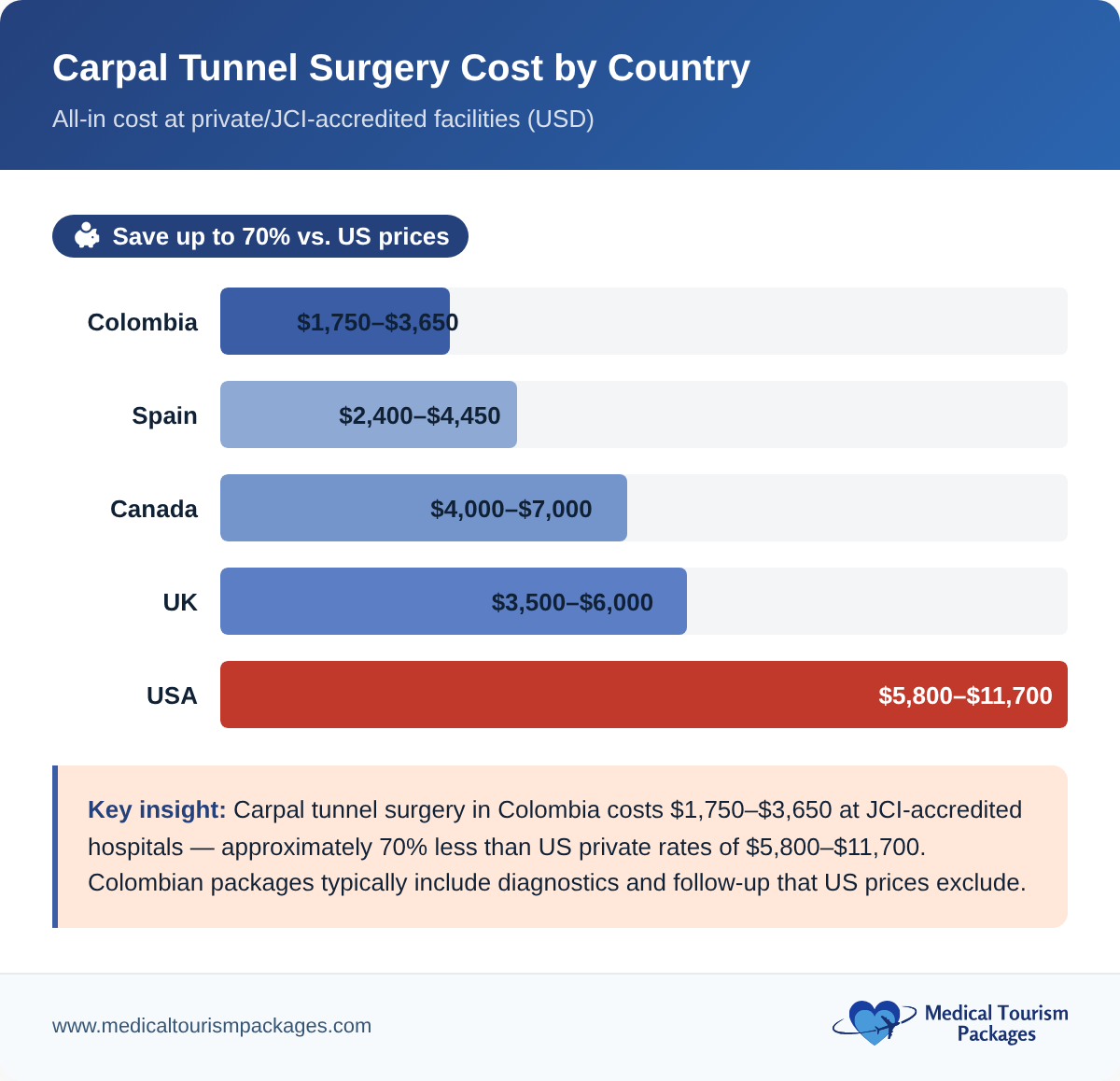
Carpal tunnel surgery in Colombia costs $1,750 to $3,650 at a JCI-accredited facility. The same procedure costs $5,800 to $11,700 in the United States. That is a saving of approximately 70%.
How Do Colombia’s Costs Compare to the US, UK, Canada, and Spain?
| Cost Component | Colombia (JCI) | USA (Private) | UK (Private) | Spain (Private) |
|---|---|---|---|---|
| Surgeon Fee | $600–$1,200 | $1,500–$3,000 | $1,200–$2,000 | $800–$1,500 |
| Anesthesia | $300–$600 | $800–$1,500 | $500–$900 | $400–$700 |
| Facility & OR | $700–$1,500 | $3,000–$6,000 | $1,500–$2,500 | $1,000–$1,800 |
| Pre-op & Follow-up | $150–$350 | $500–$1,200 | $300–$600 | $200–$450 |
| Total Estimate | $1,750–$3,650 | $5,800–$11,700 | $3,500–$6,000 | $2,400–$4,450 |
| Savings vs. USA | ~70% | — | ~45% | ~60% |
Canada ranges from $4,000 to $7,000, representing about 38% savings versus the US. Note that US and Canadian prices often exclude diagnostics and post-operative therapy. Colombian all-inclusive packages typically cover these costs.
Why Are Costs Lower in Colombia Without Compromising Quality?
The price difference is structural, not clinical. Three factors drive it.
Labor costs in Colombia are much lower than in North America or Western Europe. Malpractice insurance rates are a fraction of US equivalents. Administrative and facility overhead is reduced. None of these factors affect what happens in the operating room.
Colombian surgeons use the same techniques as US surgeons. They use the same implants and equipment. Many trained at institutions in the United States or Europe before returning to practice in Colombia. The clinical outcome is the same — the cost to deliver it is not.
Colombia’s healthcare system ranks 22nd out of 191 countries for efficiency by the World Health Organization. The United States ranks 37th. Canada ranks 30th. Lower cost in Colombia reflects a more efficient system, not a lower standard of care.
Which Hospitals Perform Carpal Tunnel Surgery in Colombia?
Colombia has three cities with JCI-accredited hospitals that perform high-volume hand surgery on international patients: Bogotá, Cali, and Medellín. Each city has at least one facility with dedicated hand surgery services and an established international patient program.
| Hospital | JCI Accredited | Hand Surgery Specialists | International Patients/Year | Airport Distance | English Available |
|---|---|---|---|---|---|
| Fundación Santa Fe de Bogotá | Yes (since 2010) | Dedicated hand unit | Not published | ~18 km, 30–50 min | Yes |
| Fundación Valle del Lili — Cali | Yes (since 2024) | 4 dedicated, 24/7 | 3,500+ (2024) | ~50 min | Yes |
| Hospital Pablo Tobón Uribe — Medellín | Yes | Dedicated unit | 2,000+ | ~45 min | Yes |
| Clínica Las Américas — Medellín | Yes | Orthopedic & hand focus | Not published | ~45 min | Yes |
What Makes Fundación Santa Fe de Bogotá Stand Out?
Fundación Santa Fe de Bogotá (FSFB) is Colombia’s most credentialed academic hospital. It was the first hospital in Colombia to achieve JCI Academic Medical Center accreditation, earning it in 2010.
FSFB holds 18 JCI Clinical Care Program Certifications — more than any other hospital in Colombia. Its orthopedic joint replacement program was the first in the country to receive JCI clinical program certification. The hospital has a formal collaboration agreement with Johns Hopkins Medicine International. It ranks 2nd in Colombia in Newsweek’s 2025 World’s Best Hospitals.
Patient rooms are double or triple standard size. Healing gardens are built throughout the building. El Dorado International Airport is about 18 km from the Usaquén and Chico medical districts — a 30 to 50 minute drive.
What Makes Fundación Valle del Lili in Cali Stand Out?
Fundación Valle del Lili (FVL) is the top-ranked hospital in Colombia in Newsweek’s 2025 World’s Best Hospitals. It ranks 4th in Latin America. It achieved JCI accreditation in November 2024 after a five-day audit across more than 1,300 standards.
FVL operates a dedicated Hand Surgery Service with four specialists available 24 hours a day, seven days a week. Its microsurgery capacity covers limb replantation and brachial plexus reconstruction. The hospital treated more than 3,500 international patients in 2024, with most coming from the United States, Germany, and Spain.
Alfonso Bonilla Aragón International Airport is about 50 minutes from FVL and the surrounding medical centers in Ciudad Jardín, Cali.
What Do Medellín Hospitals Offer for Hand Surgery?
Medellín treated 23,323 international patients in 2024, making it Colombia’s highest-volume medical tourism city. Its year-round mild climate — the city is known as the City of Eternal Spring — makes it a practical choice for a 10 to 14 day surgical recovery stay.
Hospital Pablo Tobón Uribe (HPTU) is a JCI-accredited non-profit institution with more than 2,000 international patients per year. It operates a dedicated International Patient Office that manages multilingual support, airport transfers, and accommodation coordination.
Clínica Las Américas is also JCI-accredited, with a strong orthopedic and hand surgery program. Together, the two hospitals give Medellín-bound patients two credentialed options within the same city.
José María Córdova International Airport is about 45 minutes from El Poblado, the primary medical tourism neighborhood in Medellín.
Who Are the Leading Hand Surgeons in Colombia?
The leading hand surgeons in Colombia are board-certified specialists with fellowship training in Cirugía de la Mano y Miembro Superior — Hand and Upper Extremity Surgery. This is the Colombian equivalent of a North American hand surgery fellowship.
These surgeons complete a full medical degree, a competitive orthopedic or plastic surgery residency, and then a dedicated subspecialty fellowship. Many complete part of that training at institutions in the United States or Europe before returning to practice in Bogotá, Medellín, or Cali.
Most hand surgeons at JCI-accredited facilities in Colombia’s major cities are fluent in English. They provide care specifically designed for international patients.
When researching surgeons, always verify credentials independently before committing to treatment. The next section explains exactly how to do that. For a broader look at what Colombia’s top hospitals offer across specialties, see our guide to orthopedic surgery in Colombia.
How Do You Verify a Surgeon’s Credentials in Colombia?
Never book surgery based on a website profile or a facilitator’s recommendation alone. Colombia has formal verification systems for both surgeons and facilities. Use them.
What Is RETHUS and How Do You Use It?
RETHUS — Registro Único Nacional del Talento Humano en Salud — is the Colombian government’s national health professional registry. Every licensed surgeon in Colombia must be listed. A surgeon’s presence in RETHUS confirms they have the legal right to practice.
Verification takes four steps:
- Request the surgeon’s full legal name and Cédula — their national identification number. Any legitimate surgeon will provide this without hesitation.
- Enter both into the public RETHUS portal at talenthumano.minsalud.gov.co. Confirm the license is active and the specialty is registered.
- Confirm the subspecialty fellowship is in Cirugía de la Mano y Miembro Superior — not just general orthopedics or plastic surgery. General training does not qualify a surgeon to perform complex hand and nerve procedures.
- Verify professional society membership — ASOCIMANO (Asociación Colombiana de Cirugía de la Mano) for orthopedic-trained hand surgeons, or SCCP (Sociedad Colombiana de Cirugía Plástica) for plastic-surgery-trained hand surgeons.
Watch for these red flags before committing to any surgeon:
- Reluctance to provide a Cédula number for independent verification
- Fellowship credentials listed only in vague terms such as “hand training” or “orthopedic specialization”
- No verifiable ASOCIMANO or SCCP membership
- Hospital affiliation that cannot be confirmed on the facility’s own website
- Pressure to pay a deposit before a formal consultation has taken place
What Do JCI Accreditation and Habilitación Mean for Patients?
Two certifications matter when evaluating a Colombian surgical facility.
JCI accreditation is the international gold standard. The Joint Commission International audits more than 1,300 standards covering patient safety, infection control, surgical protocols, and clinical outcomes. Earning the Gold Seal of Approval means a facility meets the same requirements as top hospitals in the United States and Europe. In Colombia, JCI-accredited hospitals treat more than 15,000 US patients annually.
Habilitación is Colombia’s mandatory national certification, issued by the Ministry of Health. Every facility that performs surgery must hold it. It confirms the clinic meets baseline national requirements for staffing, equipment, and safety protocols. Habilitación alone is not enough — but its absence is an immediate disqualifier.
The right standard for a foreign patient is both. JCI accreditation plus Habilitación together mean the facility has passed scrutiny at both the international and national level. If a clinic cannot confirm both, look elsewhere.
What Are the Success Rates and Safety Outcomes?
Colombia’s JCI-accredited hospitals publish outcomes data that can be measured against international benchmarks. The numbers support the decision to travel.
What Do the Complication and Outcomes Numbers Show?
The overall complication rate for hand surgery at accredited Colombian centers is 7.9%. The 30-day complication rate is 5.2%. Superficial infection is the most common complication. It is treatable with antibiotics and proper wound care in most cases.
For planned, non-emergency surgeries — the category carpal tunnel release falls into — the mortality rate at JCI-accredited Colombian hospitals is 0.7%. That figure comes from a study of 3,807 patients across 54 centers.
CTS-specific outcomes are strong across all technique types:
- Greater than 95% success rate for both open and endoscopic release at leading Colombian centers
- 90% of patients report no night pain after surgery
- Greater than 70% overall patient satisfaction at follow-up
- 98.2% of foreign patients say they would refer Colombia to others for the same procedure
These figures are consistent with outcomes reported at top centers in the United States and Western Europe.
How Do Colombian Hospitals Handle Complications?
JCI-accredited hospitals in Colombia maintain 24/7 anesthesia, ICU, and rehabilitation support. Complications are managed inside the same facility where surgery was performed. Patients are not transferred to separate institutions for post-operative care.
Fundación Valle del Lili in Cali has the highest level of backup available in Colombia. Its trauma and microsurgery teams operate around the clock. They are equipped for limb replantation and brachial plexus reconstruction — the most complex upper extremity emergencies that exist.
For a carpal tunnel patient, this capacity means that any complication can be managed at the same center without transfer. If worst-case scenario backup matters to you, Cali’s infrastructure is the strongest available.
What Does Recovery Look Like After Carpal Tunnel Surgery?
Carpal tunnel release is an outpatient procedure. It takes 30 to 60 minutes. You go home the same day. Recovery length depends on which surgical technique you have.
What Happens in the First 72 Hours?
You will wake up with your hand splinted and wrapped. Pain is manageable with oral medication. Most patients describe the discomfort as pressure rather than sharp pain.
In the first days after surgery:
- Day 1–2: Keep your hand elevated above heart level as much as possible. This controls swelling. Gentle finger movement is encouraged from the first day — it prevents stiffness and promotes circulation.
- Days 3–5: Your first dressing change takes place. The surgical site is checked for normal healing. Light self-care activities are allowed. Most patients are surprised by how functional their hand is at this stage.
Contact your surgeon immediately if you notice increasing redness spreading from the wound, fever above 38°C, unusual discharge, or numbness that is getting worse rather than better.
What Is the Week-by-Week Recovery Timeline?
| Phase | Timeframe | Open (OCTR) | Endoscopic (ECTR) | TCTR |
|---|---|---|---|---|
| Wound sealing | Days 7–10 | Complete; drainage subsides | Complete; drainage subsides | Complete |
| Suture removal & flight clearance | Days 10–14 | Surgeon evaluates; light exercises begin | Surgeon evaluates; light exercises begin | Earlier clearance likely |
| Light activities — typing, driving | Weeks 3–4 | Begins | Significant grip improvement noted | Normal activity from Days 3–6 |
| Full functionality & manual labor | Weeks 6–12 | Full return; scar remodeling | Full return | Confirm with surgeon |
| Remote follow-up | Ongoing | Telemedicine and WhatsApp | Telemedicine and WhatsApp | Telemedicine and WhatsApp |
The minimum recommended in-country stay is 10 to 14 days. This gets you to suture removal and surgeon clearance to fly before you travel home. After that, Colombian surgeons manage follow-up remotely via telemedicine and WhatsApp — including wound photo review, prescription adjustments, and physiotherapy guidance.
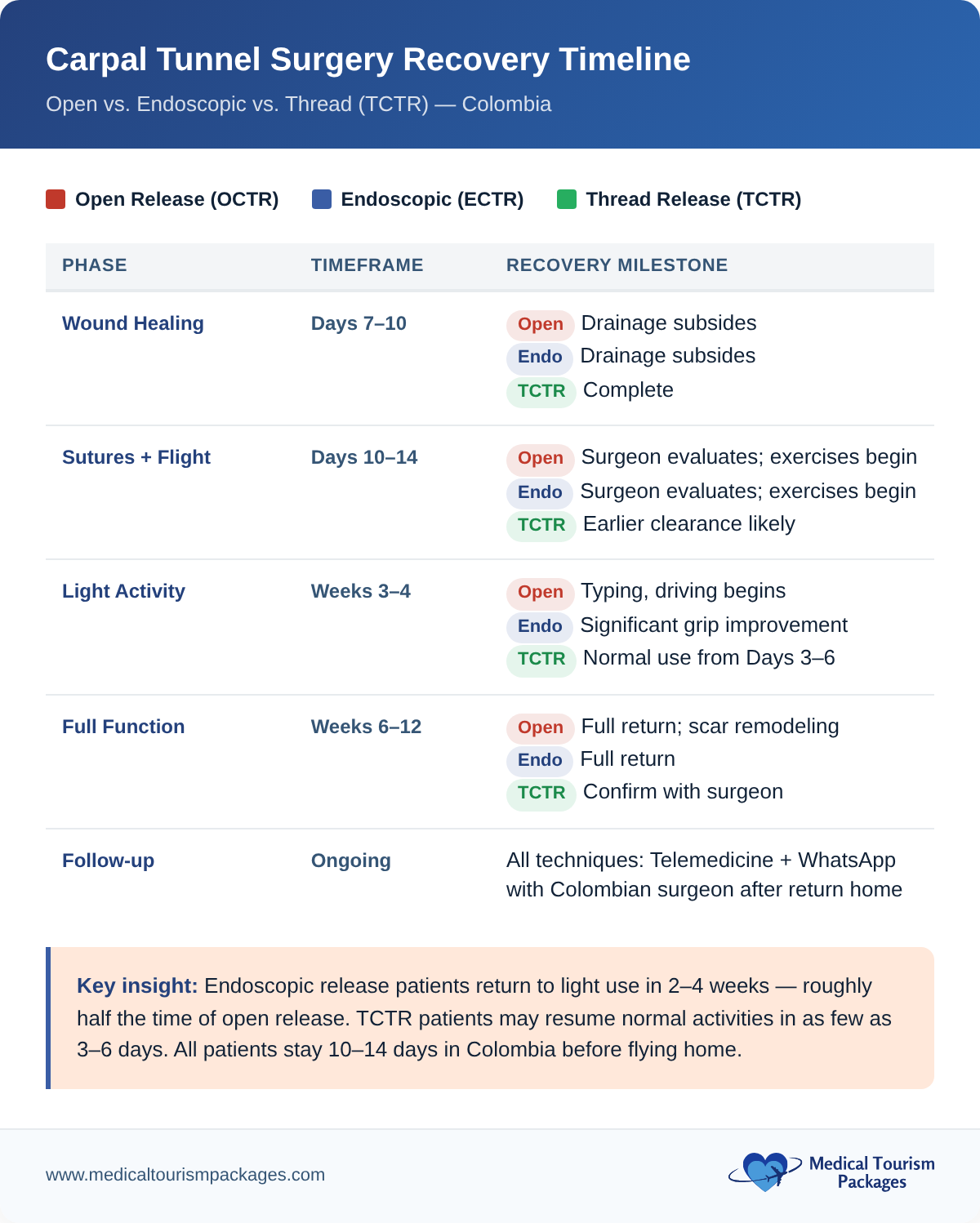
Endoscopic patients typically notice grip strength returning by weeks three to four. Open release patients reach the same point two to four weeks later. TCTR patients return to most normal activities within days rather than weeks — though long-term outcome data for this technique is still accumulating.
What Travel Logistics Do You Need to Plan For?
Carpal tunnel release requires a minimum of 10 to 14 days in Colombia. That covers surgery, your first dressing changes, suture removal, and surgeon clearance to fly. Plan your trip around that window before you book anything else.
What Are the Visa and Entry Requirements?
Most medical tourists do not need a visa. Colombia offers visa-free entry to citizens of the United States, United Kingdom, Canada, and the European Union for stays up to 90 days. That is more than enough time for surgery and recovery.
| Nationality | Entry Allowance | Notes |
|---|---|---|
| US citizens | Visa-free, 90 days | Extendable a further 90 days via Migración Colombia |
| UK citizens | Visa-free, 90 days | Extendable a further 90 days |
| EU / German citizens | Visa-free, 90 days | Extendable a further 90 days |
| Canadian citizens | Visa-free, 90 days | COP 270,000 (~$90 CAD) reciprocity fee — pay online or on arrival |
| All nationalities | Check-Mig form required | Complete digitally between 72 hours and 1 hour before your flight |
| Stays over 180 days in 12 months | Type V Medical Visa required | Apply through a Colombian consulate before travel |
The Check-Mig form is mandatory for all travelers regardless of nationality. Complete it online before departure — it takes less than ten minutes.
What Recovery Houses Are Available Near the Hospitals?
Recovery houses are a well-established part of Colombia’s medical tourism infrastructure. They sit between hospital discharge and independent hotel accommodation. You get professional nursing care, post-operative nutrition, and transport to follow-up appointments — in a private, boutique environment. Typical cost is $70 to $100 per day, all-inclusive.
| Recovery House | City | Key Services |
|---|---|---|
| Phoenix Recovery House | Medellín | 24/7 nursing care, recovery nutrition, transport to follow-up appointments |
| Recovery House Medellín | Medellín | Private suites, post-operative nutrition, close to El Tesoro medical center |
| Casa Blanca | Cali | Private community setting, 24-hour nursing, all-inclusive packages |
| Bellas Casa de Recovery | Medellín | Nursing staff, dietary supplements, secure airport transfers |
Recovery houses are particularly valuable for patients traveling alone. Having a nurse available overnight during the first week removes the biggest logistical risk of recovering abroad — being unwell without support. If you are traveling without a companion, factor a recovery house into your planning from the start. Read our Colombia medical tourism planning guide for more on logistics, accommodation, and what to expect during your stay.
What Questions Should You Ask Before Committing to Surgery in Colombia?
Every reputable Colombian surgeon will answer these questions without hesitation. If a surgeon deflects, gives vague answers, or pressures you to book before addressing them — that is your answer.
- Can you provide your full legal name and Cédula number so I can verify your registration on the RETHUS portal?
- Do you hold a subspecialty fellowship in Cirugía de la Mano y Miembro Superior — and can you provide documentation?
- Are you a current member of ASOCIMANO or the SCCP?
- How many carpal tunnel release procedures do you perform per year at this facility?
- Which surgical technique do you recommend for my case — and why that technique over the alternatives?
- Does this facility hold both JCI accreditation and Habilitación certification from the Ministry of Health?
- What is your protocol if a complication develops after I return home?
- How will we communicate during remote follow-up — and how quickly do you typically respond?
- What happens if I need to extend my stay beyond the planned 10 to 14 days?
- Can you provide my complete post-operative care plan in writing before I travel?
Send these questions before your consultation — not during it. A surgeon who answers them in writing before you book shows the transparency and communication standard you will need throughout your recovery.
What Are the Advantages and Disadvantages of Carpal Tunnel Surgery in Colombia?
What Are the Advantages of Carpal Tunnel Surgery in Colombia?
Carpal tunnel surgery in Colombia offers several key advantages for international patients:
- Savings of 50% to 70% versus US private rates — carpal tunnel release at a JCI-accredited Colombian facility costs $1,750 to $3,650, compared to $5,800 to $11,700 in the United States
- No waiting lists — surgery at leading Colombian centers is typically scheduled within one to two weeks of first contact, versus months-long waits in the UK and Canada
- Proven patient satisfaction — 98.2% of foreign surgical patients in Colombia say they would refer the country to others for the same procedure
- Fast recovery with endoscopic release — ECTR at top Colombian centers delivers return to light use in two to four weeks, with greater than 95% success rate
- Remote follow-up from home — Colombian surgeons manage post-operative care via telemedicine and WhatsApp after you return, including wound review, prescription management, and physiotherapy guidance
- Recovery house infrastructure — professionally staffed recovery houses near major hospitals in Bogotá, Medellín, and Cali cost $70 to $100 per day all-inclusive
What Are the Disadvantages of Carpal Tunnel Surgery in Colombia?
There are also important limitations to consider:
- Minimum 10 to 14 days away from home — carpal tunnel release requires staying in Colombia through suture removal and surgeon flight clearance before you can travel safely
- Post-operative physiotherapy must be arranged independently — Colombian surgeons guide your rehab remotely, but you will need to source and book a physiotherapist in your home country before you travel
- TCTR is not universally available — thread carpal tunnel release is an emerging technique and is not yet confirmed at all Colombian centers; verify availability before committing
- Language barrier outside hospital environments — JCI-accredited hospitals have English-speaking staff, but pharmacies, local transport, and recovery houses vary in their English capability
- Extended stays carry logistical risk — if a complication delays your clearance to fly, additional accommodation, rebooking fees, and time away from work fall entirely on you to manage
Is Carpal Tunnel Surgery in Colombia Right for You?
Colombia is a strong option for carpal tunnel surgery. The cost savings are real. The hospitals are internationally accredited. The surgeons are fellowship-trained.
You are a good candidate if you meet these conditions:
- Your conservative treatment has failed after three to six months
- You can commit to 10 to 14 days in Colombia
- You are comfortable managing your post-operative physiotherapy at home after returning
- You are willing to do the verification work — RETHUS, JCI accreditation, Habilitación — before you book
Colombia is less suitable if your case is unusually complex, if you have significant health conditions that require close monitoring during recovery, or if you cannot arrange adequate support at home for the weeks following your return.
The decision comes down to three things: cost, access, and trust. On cost, Colombia is difficult to beat. On access, leading hospitals in Bogotá, Medellín, and Cali can schedule you within weeks, not months. On trust, the verification tools exist — RETHUS, JCI accreditation, ASOCIMANO membership — and they work. The burden is on you to use them.
Patients who research carefully, choose JCI-accredited facilities, verify their surgeon’s credentials independently, and plan their recovery properly consistently report outcomes that match what they would expect at home — at a fraction of the price.
Ready to Start Your Carpal Tunnel Surgery Journey?
Medical Tourism Packages coordinates your entire carpal tunnel surgery journey in Colombia. We connect you with fellowship-trained hand surgeons at JCI-accredited hospitals in Bogotá, Medellín, and Cali, arrange your travel and accommodations, and provide bilingual support throughout your treatment. Get a free consultation to discuss your hand health goals and receive a personalized quote.
Contact us today to start planning your affordable carpal tunnel surgery in Colombia.