Book Appointment Now


Bariatric Surgery in Panama: Complete Guide, Costs, and What Medical Tourists Should Know
 By
By
Bariatric surgery in Panama costs $10,500-$14,000, which is 45% less than US prices. American Board of Surgery-certified surgeons perform these procedures at JCI-accredited hospitals.
Panama’s top bariatric centers include Hospital Punta Pacifica (Johns Hopkins-affiliated) and Clinica Hospital San Fernando. They perform gastric sleeve ($10,500) and gastric bypass ($14,000) procedures. Surgeons like Dr. Debbie Wong and Dr. Richard Altieri hold ABS certification with training from Mount Sinai and University of Miami.
Our network connects you with board-certified bariatric surgeons across Panama City. Each surgeon is verified for credentials, facility accreditation, and patient outcomes. Below, you’ll find cost comparisons, procedure details, hospital profiles, surgeon credentials, and recovery timelines.
What is Bariatric Surgery?
Bariatric surgery is a group of weight loss procedures for people with severe obesity. These surgeries work by limiting how much food your stomach can hold. Some also reduce nutrient absorption. Others combine both approaches.
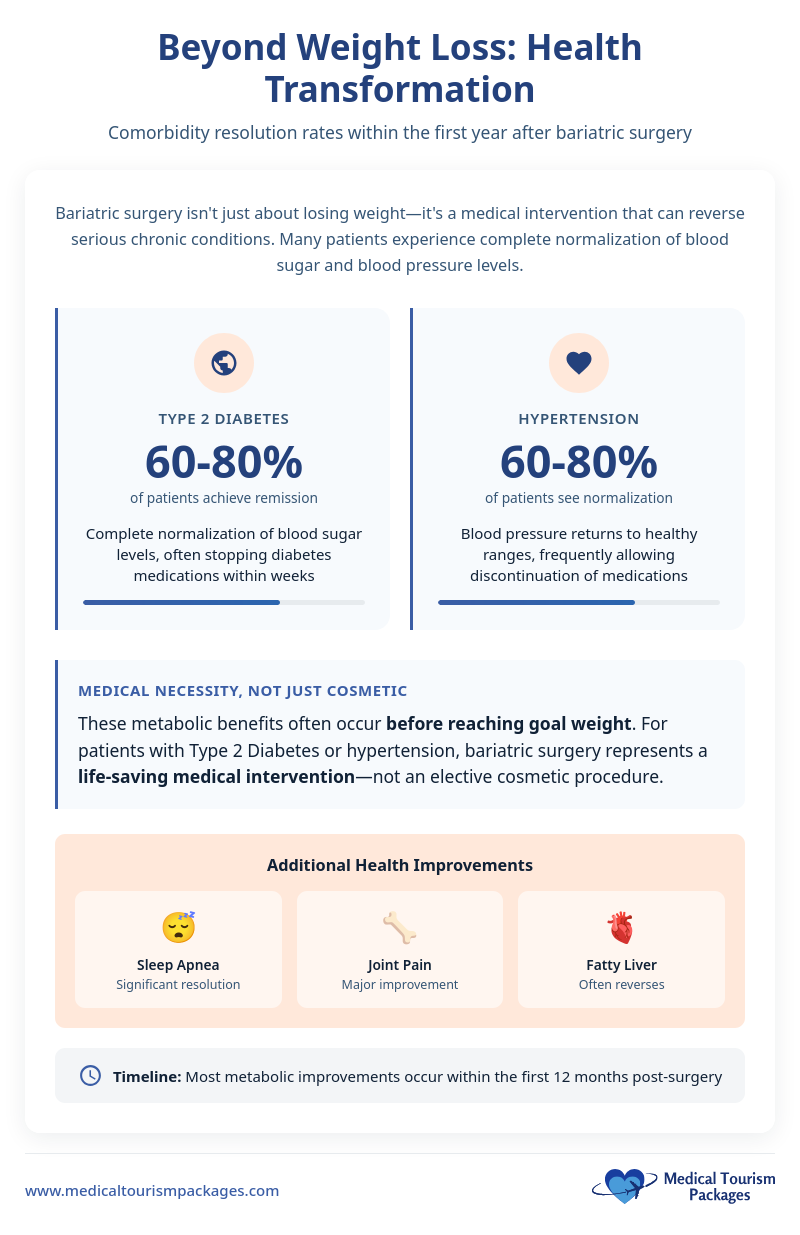
The benefits go beyond weight loss. Between 60% and 80% of patients with Type 2 Diabetes see normal blood sugar within the first year. The same percentage of patients with high blood pressure see it return to normal. These procedures help patients who have tried diet and exercise without success.
What Types of Bariatric Surgery Are Available in Panama?
Panama’s bariatric centers offer four main weight loss procedures. Each is designed for different patient needs and goals.
Laparoscopic Sleeve Gastrectomy (VSG): The most common bariatric procedure worldwide. Surgeons remove about 80% of your stomach. This leaves a narrow, tube-shaped stomach. Patients lose 60-70% of excess weight at 12 months. Hospital stay is 1-2 nights.
Roux-en-Y Gastric Bypass (RYGB): The “gold standard” for metabolic control. This works especially well for Type 2 Diabetes. The surgeon creates a small stomach pouch. It connects directly to the small intestine. This combines restriction with reduced absorption. Patients lose 70-80% of excess weight at 12 months. Hospital stay is 2-3 nights.
Gastric Band Surgery (LAP-BAND): An adjustable silicone band goes around the upper stomach. This creates a small pouch that limits food intake. The band can be tightened or loosened over time through a port under the skin.
Duodenal Switch Surgery: A complex procedure for patients with very high BMI. This combines stomach reduction with major intestinal bypass. It offers the highest weight loss results among all bariatric procedures.
For more details on weight loss surgery across Latin America, see our complete guide to bariatric surgery.
Why Choose Panama for Bariatric Surgery?
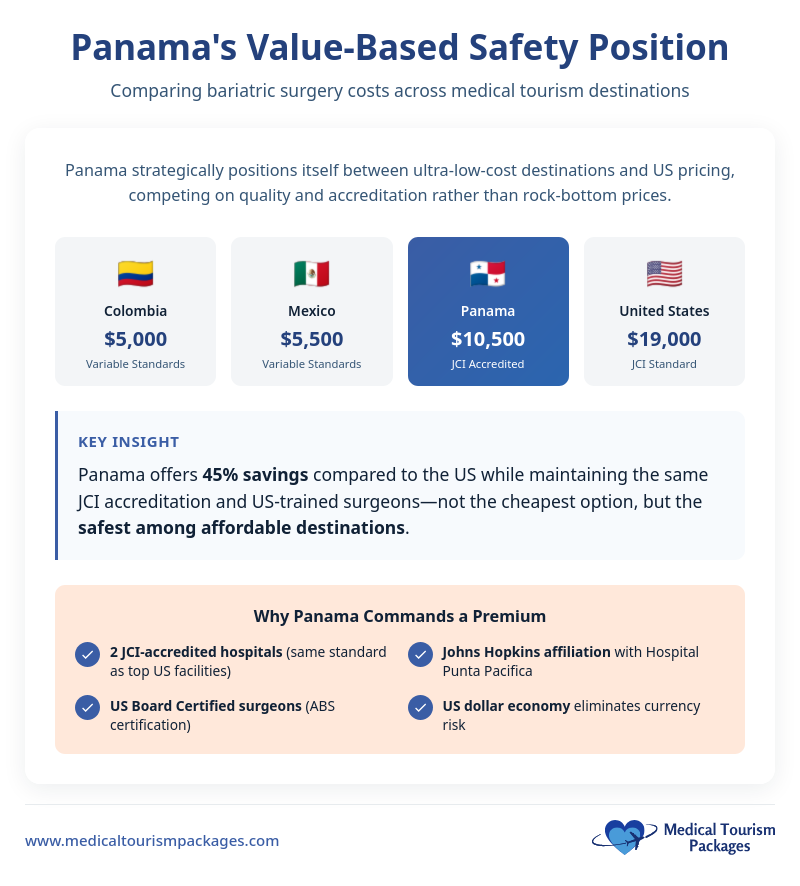
Panama offers US-level quality at 45% lower prices. The country focuses on safety and international standards, not just low costs.
Panama has used the US dollar since 1904. Your surgical quote stays fixed. No surprise price increases from currency changes. Direct flights from Miami reach Panama City in under 3 hours. Houston and New York connect in under 5 hours.
Short flights matter for bariatric patients. Long flights increase the risk of blood clots and pulmonary embolism. Obese patients face higher risk during long-haul travel.
Panama has two JCI-accredited hospitals. These meet the same standards as top US hospitals. Leading surgeons hold American Board of Surgery certification. Many trained at Mount Sinai, University of Miami, and Johns Hopkins.
The private healthcare sector operates bilingually. Doctors, nurses, and staff speak English fluently. Hospitals use equipment from major US manufacturers like Medtronic and Ethicon.
How Much Does Bariatric Surgery Cost in Panama?
Gastric sleeve costs $10,500 and gastric bypass costs $14,000 in Panama. This is 45-46% less than US prices.
| Procedure | US Average Price | Panama Average Price | Estimated Savings |
|---|---|---|---|
| Gastric Sleeve | $19,000 | $10,500 | ~45% ($8,500) |
| Gastric Bypass | $26,000 | $14,000 | ~46% ($12,000) |
| Revision Surgery | $28,000+ | $14,500 | ~48% ($13,500+) |
| Lap Band | $15,000 | $8,500 | ~43% ($6,500) |
Lower costs come from reduced overhead and malpractice insurance. Surgical equipment quality matches US operating rooms.
Most Panama packages include:
- Hospital fees
- Surgeon fees
- Anesthesiologist fees
- Surgical supplies
- Pre-operative testing
- Post-operative follow-up
Travel costs, hotels, and extended recovery stays are not included in the quoted price.
What Are the Top Hospitals for Bariatric Surgery in Panama?
Three top hospitals serve bariatric patients: Hospital Punta Pacifica, Clinica Hospital San Fernando, and The Panama Clinic.
| Hospital | Key Highlights | Best For |
|---|---|---|
| Hospital Punta Pacifica | First hospital in Latin America with Johns Hopkins affiliation. JCI accredited since 2011. Has Hugo RAS and Da Vinci surgical robots. Level 3 ICU with 24-hour specialists. Ocean view rooms with companion beds. | High-risk patients, complex revision surgeries, super-obese individuals (BMI > 50), premium service seekers |
| Clinica Hospital San Fernando | Founded 1949. Panama’s first JCI accreditation. Affiliated with Tulane Medical Center and Baptist Health South Florida. High-volume center. Central location with family-friendly private rooms. | Value-conscious patients, standard primary procedures, mid-range pricing |
| The Panama Clinic | Ultra-modern facility with robotic surgery systems. Multilingual international team. 4-star Global Hospital Rating by Statista & Newsweek. TEMOS certification for medical tourism. Executive concierge services. | Executive patients, luxury service seekers, business travelers |
Learn more about surgical procedures available in Panama.
Who Are the Leading Bariatric Surgeons in Panama?
Panama’s top bariatric surgeons share a common background. They earn medical degrees in Panama. Then they complete residencies and fellowships at major US institutions.
Dr. Debbie Wong completed her General Surgery residency at Mount Sinai in Chicago and New York. She did a Bariatric Surgery Fellowship at University of Miami and Jackson Memorial Hospital. She holds American Board of Surgery certification. She manages complex procedures including gastric bypass and revision surgeries.
Dr. Richard Altieri brings ABS certification and FACS credentials. He specializes in minimally invasive and robotic surgery. He uses Da Vinci and Hugo RAS robotic systems. These offer better precision, smaller incisions, and faster recovery.
Dr. Alberto Navarro holds both FACS and ABS credentials. He takes a unique approach that combines nutrition with surgery. He helps patients navigate dietary challenges during their weight loss journey.
You can verify surgeon credentials through the American Board of Surgery website at www.absurgery.org. The “Consejo Técnico de Salud” mobile app from Panama’s Ministry of Health confirms legal authorization to practice.
Who Qualifies for Bariatric Surgery in Panama?
You qualify if your BMI is 35 or higher. Patients with obesity-related conditions like diabetes or sleep apnea may qualify at lower BMI.
| Qualification Criteria | Requirements | Recommended Procedure |
|---|---|---|
| BMI 35-50 | Major obesity requiring intervention | Gastric Sleeve |
| BMI > 45-50 | Higher obesity with comorbidities | Gastric Bypass preferred |
| BMI > 50 (Super-Obese) | Requires Level 3 ICU support | Either procedure with specialized care |
| Type 2 Diabetes | Seeking metabolic control and remission | Gastric Bypass (better hormonal benefits) |
| Severe GERD | Medication-resistant reflux | Gastric Bypass (resolves acid diversion) |
| Hypertension | High blood pressure requiring medication | Either procedure |
| Sleep Apnea | Obesity-related breathing problems | Either procedure |
Some conditions make surgery medically necessary, not just elective. Between 60-80% of diabetic patients achieve complete remission within the first year. The same percentage of patients with high blood pressure see their readings normalize.
How Do You Prepare for Bariatric Surgery in Panama?
Preparation begins weeks before your departure. You’ll submit your weight history, previous weight loss attempts, current medications, and prior surgeries. Your local doctor must provide written clearance for surgery and international travel.
Patients over 50 or those with heart risk factors need cardiac clearance. This typically includes a stress test or echocardiogram from your local cardiologist.
You must follow a liver-shrinking diet for two weeks before surgery. This diet is low-carb and high-protein liquids only. It reduces liver size and makes surgery safer.
Upon arrival in Panama, you’ll visit the hospital 1-2 days before surgery. You’ll complete final blood work and chest X-rays. You’ll meet the anesthesia team. They will review your airway and create a customized plan.
Read our comprehensive guide for American medical tourists in Panama for more planning tips.
How Long Do You Need to Stay in Panama?
Plan for 7-10 days total. This covers pre-operative appointments through clearance for air travel.
Hospital stay varies by procedure. Gastric sleeve patients stay 1-2 nights. Gastric bypass patients stay 2-3 nights.
After discharge, you’ll recover at a nearby hotel. Most patients stay in the Punta Pacífica neighborhood near the hospital.
Before your return flight, your surgeon will confirm:
- Your staple line is healing properly
- You’re medically stable for air travel
Panama offers beautiful sights, but plan for very limited activity. Light walking is encouraged. Strenuous activity is prohibited during early recovery.
What Is the Recovery Process After Bariatric Surgery?
Recovery takes 7-10 days in Panama. Your hospital stay is 1-3 nights depending on procedure type.
All private rooms accommodate a companion on a sleeper sofa. Nurses monitor vital signs every few hours. They manage your pain medication.
You’ll start walking within hours of surgery. Walking promotes blood flow and prevents blood clots. The nursing staff will help you walk in the hallway multiple times per day.
| Phase | Timeline | What You Can Eat |
|---|---|---|
| Pre-Operative | 2 weeks before surgery | Low-carb, high-protein liquids only (liver-shrinking diet) |
| Clear Liquids | Days 1-7 post-surgery | Water, clear broth, sugar-free gelatin, diluted protein shakes |
| Soft Mechanical | Days 7-30 | Full liquids, pureed foods, yogurt, mashed vegetables |
| Solid Foods | Month 2+ | Gradual reintroduction starting with soft proteins |
Important: Wait 30 minutes after eating solid food before drinking liquids. This prevents your stomach pouch from emptying too fast.
Vitamin supplements are required for life. Start a multivitamin with folic acid one week after surgery. All patients need calcium citrate, vitamin D, and B12. Gastric bypass patients need additional iron, vitamins A and E.
Blood tests are required for life. Tests check vitamin and mineral levels. They catch deficiencies before symptoms appear. Testing happens quarterly in year one. Then it moves to annual monitoring. Your local doctor can order tests and share results with your Panama team.
What Results Can You Expect from Bariatric Surgery?
Gastric sleeve produces 60-70% excess weight loss at 12 months. Gastric bypass produces 70-80% excess weight loss at 12 months.
For example: If you’re 100 pounds overweight, gastric sleeve would result in losing 60-70 pounds. Gastric bypass would result in losing 70-80 pounds by your one-year mark.
Most weight loss occurs in the first 12-18 months. Gastric bypass weight loss continues for 18-24 months total.
Health improvements often happen before reaching goal weight:
- 60-80% of diabetic patients see normal blood sugar within year one
- Many stop diabetes medications within weeks
- Same percentage of patients with high blood pressure return to normal
- Many discontinue blood pressure medications completely
Complication rates match US standards. Serious complications like staple line leaks and bleeding occur in 0.5-2.5% of cases at JCI-accredited Panama facilities.
Additional improvements include:
- Resolution or improvement in sleep apnea
- Reduced joint pain
- Improved fatty liver disease
- Improved fertility
Most patients describe surgery as life-changing. Not just for the weight lost, but for the health and vitality gained.
Is Panama the Right Choice for Your Bariatric Surgery?
Panama offers 40-70% cost savings compared to US prices. It maintains comparable safety through JCI accreditation. Surgeons hold American Board of Surgery certification.
Panama works well for:
- Complex cases
- Revision surgeries
- Patients with BMI over 50 who need Level 3 intensive care
Direct flights from major US cities take under 5 hours. This reduces blood clot risk compared to longer journeys. English-speaking staff and Johns Hopkins affiliation give American patients confidence.
Before traveling: Coordinate with your local primary care doctor. They will handle lifelong blood work monitoring. Many US bariatric surgeons won’t follow up on patients operated abroad. Confirm your PCP will order necessary labs and communicate with your Panama team.
Panama is ideal if you want:
- US-caliber medical care at international pricing
- Surgeons with American credentials
- Advanced robotic surgery capabilities
- Convenient travel logistics
With proper preparation and local doctor support, Panama provides an outstanding path to major weight loss and better health.
Frequently Asked Questions
Will my US health insurance cover complications from surgery in Panama?
No. US insurance companies typically do not cover complications from procedures performed abroad. You may need to pay out of pocket for emergency care or corrective surgery after returning home. Consider purchasing medical tourism insurance before your trip. These specialized policies cover extended stays, emergency transport, and complication-related expenses that standard travel insurance excludes.
How can I finance bariatric surgery in Panama?
Several options exist beyond paying in full upfront. Many patients use Health Savings Accounts (HSA) or Flexible Spending Accounts (FSA) for tax-advantaged payment. Medical credit cards like CareCredit offer promotional financing periods. Personal loans from medical lenders like Prosper Healthcare Lending offer terms of 2-5 years. Some Panama clinics offer payment plans with 10-25% down and monthly installments over 12-24 months.
How soon can I return to work after bariatric surgery?
Desk job workers typically return in 1-2 weeks. Jobs requiring physical labor need 4-6 weeks off. Avoid lifting more than 15 pounds for the first several weeks. Your surgeon will provide clearance based on your healing progress and job requirements.
What if I have complications after returning to the United States?
Establish a relationship with a local primary care physician before traveling. Some US bariatric surgeons are reluctant to treat complications from surgeries performed abroad. Your Panama surgical team can provide telemedicine consultations and coordinate with your local doctor. Keep all surgical records, discharge summaries, and your surgeon’s contact information easily accessible.
Can I get revision surgery in Panama if my original surgery was elsewhere?
Yes. Panama’s bariatric centers regularly perform revision surgeries for patients whose original procedures were done in the US or other countries. Revision surgery costs about $14,500 in Panama. Bring complete records from your original surgery including operative reports and any imaging studies.
How long should I wait to get pregnant after bariatric surgery?
Wait 12-24 months after surgery before conceiving. This allows your weight to stabilize and reduces risk of nutritional deficiencies that could affect fetal development. Oral contraceptives may be less effective after gastric bypass due to reduced absorption. Discuss alternative birth control options like an IUD with your doctor. Pregnancy after bariatric surgery is considered high-risk and requires close monitoring.
Ready to Start Your Weight Loss Surgery Journey?
Medical Tourism Packages coordinates your entire bariatric surgery journey in Panama. We connect you with board-certified surgeons. We arrange your travel and accommodations. We provide bilingual support throughout your treatment. Get a free consultation to discuss your weight loss goals and receive a personalized quote.
Contact us today to start planning your affordable bariatric surgery in Panama.