Book Appointment Now


Bariatric Surgery in Mexico: Complete Guide for Medical Tourists, Costs, and Safety Standards
 By
By
Bariatric surgery in Mexico saves 70-80% compared to US prices at internationally accredited hospitals.
Mexico’s top bariatric centers perform thousands of weight loss procedures each year. Costs range from $3,995-$12,000, which is 60-80% less than $15,000-$38,000 in the US. Surgeons in Tijuana, Cancun, Mexicali, and Guadalajara focus only on weight loss surgery.
Our network connects you with board-certified surgeons across Mexico’s leading bariatric hubs. Each facility is verified for JCI, SRC, or CSG accreditation. Below, you’ll find cost comparisons, procedure details, safety standards, and recovery timelines.
What Is Bariatric Surgery in Mexico?
Bariatric surgery in Mexico is weight loss surgery performed at specialized Mexican hospitals and clinics. These facilities treat obesity and metabolic disorders at a fraction of US costs.
What Procedures Does Bariatric Surgery in Mexico Include?
Mexican surgeons perform the same procedures available in the US and Canada. These include gastric sleeve, gastric bypass, duodenal switch, and gastric banding. The difference is cost, not quality of care.
Why Has Mexico Become a Leading Destination for Bariatric Surgery?
Mexico is the top global destination for bariatric surgery. Its border cities sit minutes from US airports. Tijuana and Mexicali are a short drive from California. This makes Mexico the most accessible option for North American patients.
Who Travels to Mexico for Bariatric Surgery?
Most patients come from the United States and Canada. Many cannot afford the $15,000-$38,000 price tag at home. Others face strict insurance rules. These include six-month diet programs and mental health checks. Mexican facilities welcome self-pay patients without these barriers.
Why Should You Choose Mexico for Bariatric Surgery?
You should choose Mexico for bariatric surgery because of major cost savings without sacrificing quality. A gastric sleeve costs $3,995-$6,500 in Mexico. The same procedure runs $15,000-$22,000 in the US.
What Makes Mexican Bariatric Surgery More Affordable?
Mexican hospitals have lower operating costs. Nurses and surgical staff earn competitive local wages. Real estate costs less than in the US. Facilities skip the large medical liability insurance costs. Everything comes in one bundled price.
How Does High Volume Benefit Mexican Bariatric Surgeons?
Mexico’s bariatric market is competitive and volume-driven. Cities like Tijuana host dozens of clinics. This competition keeps prices low and quality high. Top surgeons perform 10-20 procedures per week. They focus only on metabolic surgery. This builds expertise that benefits patient outcomes.
How Much Does Bariatric Surgery Cost in Mexico?
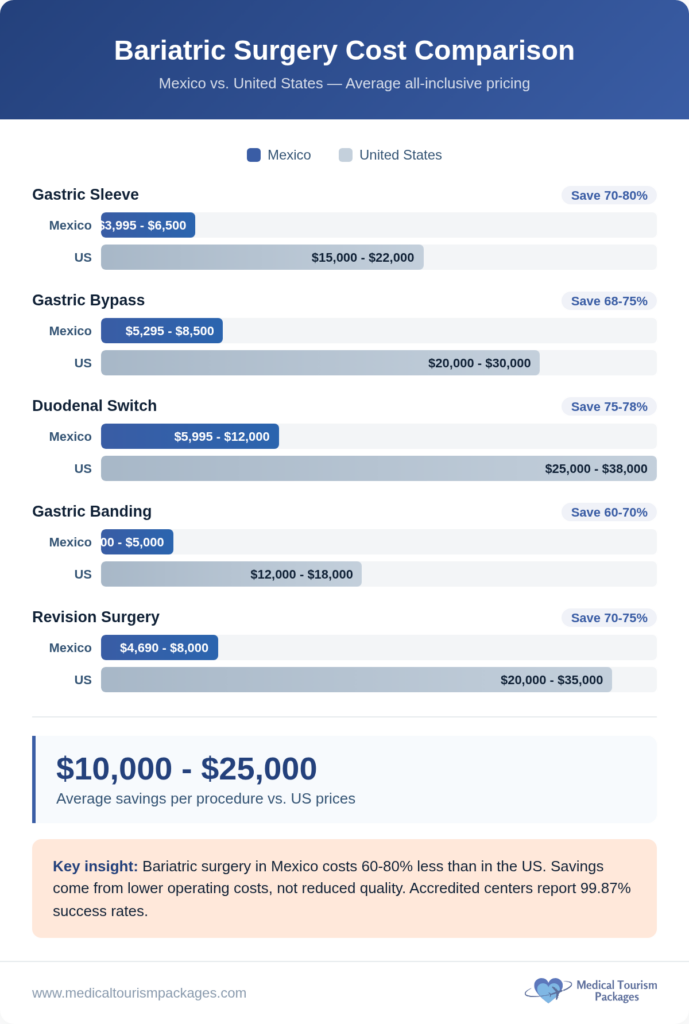
Bariatric surgery in Mexico costs 60-80% less than in the US or Canada. The table below shows current prices for all major procedures.
| Procedure Type | Mexico Price | US Price | Canada Price | Savings |
|---|---|---|---|---|
| Sleeve Gastrectomy | $3,995 – $6,500 | $15,000 – $22,000 | $12,000 – $18,000 | 70-80% |
| Gastric Bypass | $5,295 – $8,500 | $20,000 – $30,000 | $15,500 – $22,000 | 68-75% |
| Mini Gastric Bypass | $4,999 – $7,000 | $18,000 – $25,000 | $15,000 – $20,000 | 65-72% |
| Duodenal Switch | $5,995 – $12,000 | $25,000 – $38,000 | $20,000 – $35,000 | 75-78% |
| SADI-S / SIPS | $6,500 – $9,500 | $22,000 – $32,000 | $18,000 – $28,000 | 65-70% |
| Gastric Banding | $3,000 – $5,000 | $12,000 – $18,000 | $10,000 – $15,000 | 60-70% |
| Gastric Balloon | $2,995 – $4,500 | $8,000 – $12,000 | $7,000 – $10,000 | 60-70% |
| Revision Surgery | $4,690 – $8,000 | $20,000 – $35,000 | $18,000 – $30,000 | 70-75% |
What Factors Affect Bariatric Surgery Costs in Mexico?
Several factors affect your final price. Location matters most. Tijuana offers the lowest prices due to strong competition. Cancun and Puerto Vallarta charge more for luxury recovery settings.
Does Your BMI Affect the Price?
Yes, your BMI can affect the price. Patients with a BMI above 50 or 60 often pay $500-$1,000 extra. This covers longer surgery time and extra surgical supplies.
Does Facility Accreditation Affect Cost?
Yes, accreditation level affects cost. JCI-certified hospitals in cities like Cancun typically charge more. Basic accredited centers offer lower prices.
For more details on costs and what’s included, see our complete guide to bariatric surgery procedures.
What Types of Bariatric Surgery Are Available in Mexico?
Mexican bariatric centers offer all major weight loss procedures. Your surgeon recommends a procedure based on your BMI, health conditions, and weight loss goals.
What Is Gastric Sleeve Surgery?
Gastric sleeve is the most popular procedure for medical tourists. The surgeon removes about 80% of the stomach. This leaves a banana-shaped sleeve. It reduces hunger and limits food intake. The surgery takes 30-60 minutes through small incisions. Patients lose 51-65% of excess weight within 12 months. Mexican surgeons report leak rates of 0.00-0.03%. This is much lower than the US average of 0.1-0.5%.
What Is Gastric Bypass Surgery?
Gastric bypass uses the Roux-en-Y technique. It is the most common procedure in Mexican registries. The surgeon creates a small stomach pouch. Then they reroute part of the small intestine. This limits food intake and reduces calorie absorption. Patients lose 65-77% of excess weight at 12 months. The procedure shows strong metabolic benefits. Up to 54-100% of patients see type 2 diabetes remission within five years.
What Is Duodenal Switch Surgery?
Duodenal switch is the most aggressive bariatric procedure. It combines sleeve gastrectomy with major intestinal bypass. Patients lose 75-94% of excess weight at 12 months. It works best for patients with BMI above 60. The SADI-S variant is a simpler version. It offers strong metabolic impact but requires lifelong vitamin supplements.
What Is Gastric Banding?
Gastric banding places an adjustable band around the upper stomach. It costs $3,000-$5,000 in Mexico. The band limits food intake by creating a small pouch. It is adjustable and reversible. However, it produces less weight loss than other options.
Where Are the Best Bariatric Surgery Locations in Mexico?
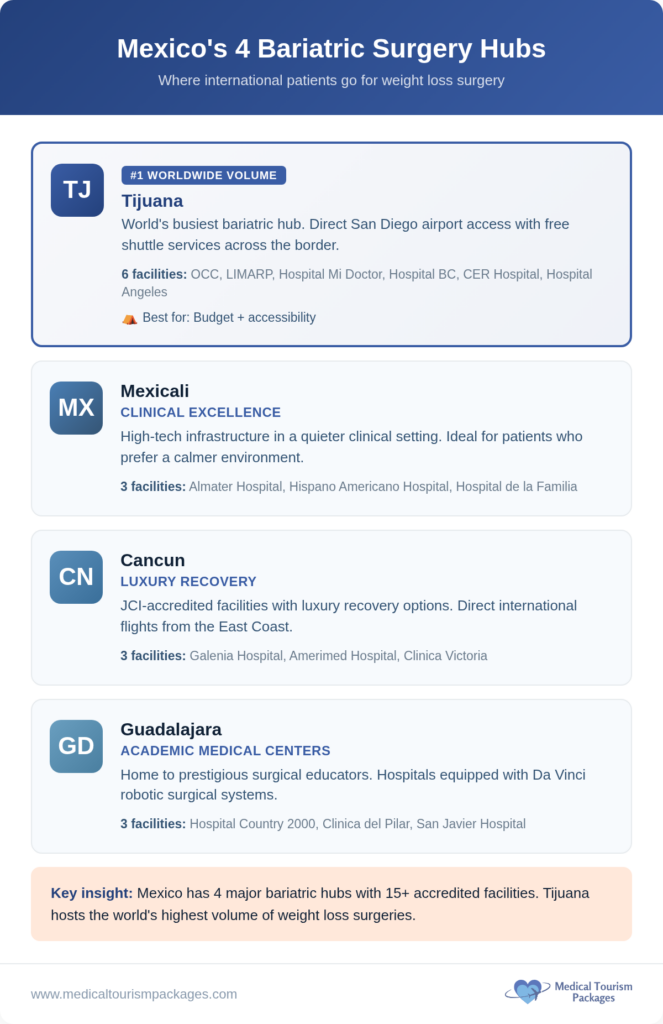
Bariatric surgery in Mexico centers around four main hubs. Each offers different benefits for medical tourists.
| Location | Top Facilities | Key Features |
|---|---|---|
| Tijuana | Obesity Control Center, LIMARP, Hospital Mi Doctor, Hospital BC, CER Hospital, Hospital Angeles | Highest volume worldwide with direct San Diego airport access and shuttle services |
| Mexicali | Almater Hospital, Hispano Americano Hospital, Hospital de la Familia | High-tech infrastructure in a quieter clinical environment |
| Cancun | Galenia Hospital, Amerimed Hospital, Clinica Victoria | JCI-accredited facilities with luxury recovery and direct international flights |
| Guadalajara | Hospital Country 2000, Clinica del Pilar, San Javier Hospital | Academic medical centers with Da Vinci robotic surgical systems |
Why Is Tijuana the Most Popular Bariatric Destination?
Tijuana is the world’s busiest bariatric hub. It sits just south of San Diego, California. Patients can drive across the border. Clinics offer free shuttle service from the San Diego airport. The high volume of clinics keeps prices competitive.
What Makes Cancun and Guadalajara Different?
Cancun appeals to patients who want luxury recovery. Its hospitals hold JCI accreditation. They accept direct international flights from the East Coast. Guadalajara attracts patients who want academic credentials. Its hospitals use Da Vinci robotic surgical systems for greater precision.
Read our comprehensive guide for American medical tourists in Mexico for more planning tips.
Is Bariatric Surgery in Mexico Safe?
Yes, bariatric surgery in Mexico is safe when you choose accredited facilities. Top Mexican hospitals meet the same international standards as US facilities. They maintain infection rates below 0.1%. Complication rates run 0.13-0.22%, far below the US average of 4%.
What Accreditations Should You Look For?
Look for these four key accreditations when choosing a facility:
- JCI (Joint Commission International): The gold standard for global healthcare. It evaluates over 300 standards. These cover surgical safety, medication management, and infection control.
- SRC (Surgical Review Corporation): Provides “Center of Excellence” status for bariatric surgery. It verifies specialized equipment and trained staff.
- CSG (Consejo de Salubridad General): Mexico’s national hospital certification. It equals international accreditation standards.
- COFEPRIS: Mexico’s health safety regulator. All facilities must hold this license. It covers operating rooms and cleaning systems.
What Surgeon Credentials Should You Verify?
Your surgeon should hold double board certification. This means certification from both CMCG and CMCOEM. CMCOEM validates specific bariatric expertise. Top surgeons also hold international fellowships. These include FACS, IFASMBS, and IFSO. These credentials confirm training consistent with US and Canadian standards.
What Are the Success Rates for Bariatric Surgery in Mexico?
Accredited Mexican centers report outcomes that match or beat US standards. Success means no major complications plus expected weight loss achieved.
| Outcome Metric | Mexican Centers | US Standards |
|---|---|---|
| Overall Success Rate | 99.87% | 95-98% |
| Major Complication Rate | 0.13-0.22% | ~4% |
| Mortality Rate | <0.1% | 0.1% |
| Leak Rate (Gastric Sleeve) | 0.00-0.03% | 0.1-0.5% |
| 5-Year Diabetes Remission | 54-100% | 38-54% |
Why Are Mexican Success Rates So High?
These results reflect high-volume practice. Top specialists perform 10-20 procedures per week. This repetition builds refined technique. Clinics compete for international patients. This drives continuous quality improvement.
How Reliable Are These Statistics?
These statistics come from accredited, high-volume centers. They participate in international registries. Not all Mexican facilities achieve these results. Always verify your chosen clinic’s published outcomes data.
What Is the Patient Journey for Bariatric Surgery in Mexico?
The typical bariatric journey in Mexico follows a 4-5 day timeline. This structured approach reduces risk for traveling patients.
| Day | Milestone | Key Activities |
|---|---|---|
| 1 | Arrival & Assessment | Airport pickup, hospital check-in, blood panels, EKG, and final surgeon meeting |
| 2 | Surgery Day | 30-60 minute minimally invasive procedure with walking within 4 hours |
| 3 | Recovery | IV fluids, pain management, nutritionist meeting, leak test X-ray |
| 4 | Discharge | Wound dressing, take-home medication kit, transfer to hotel or airport |
What Happens Before You Arrive in Mexico?
Your journey starts weeks earlier with a virtual meeting. You submit your medical history and weight loss goals. Facilities usually require a $295-$500 deposit. This secures your surgical date.
How Long Is the Hospital Stay?
Most sleeve patients stay four days in Mexico. Gastric bypass and duodenal switch may need a fifth day. Your team monitors you closely during the full stay.
What Post-Discharge Support Do You Receive?
Support continues for 12 months after surgery. You get telehealth access to a nutritionist. A medical coordinator guides you through dietary phases. Clinics provide tracking apps for food, protein, and supplements.
What Should You Expect During Recovery?
Recovery follows a strict four-phase diet plan. This prevents complications and lets your stomach heal properly.
What Is the Clear Liquids Phase?
Phase 1 covers week one. You drink only clear liquids. These include water, clear broth, and sugar-free gelatin. Sip slowly throughout the day. Your new stomach holds only 2-4 ounces. Aim for 64 ounces of total fluid daily.
What Is the Full Liquids Phase?
Phase 2 covers week two. You add protein shakes and strained cream soups. Plain yogurt without chunks is allowed. Focus on 60-80 grams of protein daily through supplements.
What Is the Pureed Foods Phase?
Phase 3 covers weeks three and four. You eat soft, pureed foods. These include scrambled eggs, cottage cheese, and blended chicken. Measure portions to 2-4 ounces per meal. Eat slowly over 20-30 minutes.
When Can You Eat Solid Foods Again?
Phase 4 starts around month 1.5. You gradually add soft solid foods. Start with tender meats and cooked vegetables. Eat lean proteins first. Then add non-starchy vegetables. Keep portions to 4-6 ounces.
How Do You Prevent Blood Clots During Travel?
Wear compression stockings from surgery through your flight home. Walk the airport terminal before boarding. Flex your feet up and down every 30 minutes during the flight. Stay hydrated throughout your journey.
How Do You Verify a Bariatric Surgeon’s Credentials in Mexico?
You can verify credentials by requesting documentation directly. Reputable surgeons welcome these inquiries.
What Should Your Verification Checklist Include?
Follow this four-step checklist before choosing a surgeon:
- Board certification: Confirm dual certification from CMCG and CMCOEM. Request the certification numbers.
- International fellowships: Ask about FACS, IFASMBS, and IFSO credentials. These meet US and Canadian training standards.
- Surgical volume: Ask how many procedures the surgeon performs weekly. Top specialists do 10-20 per week.
- Facility accreditation: Confirm the hospital holds JCI, SRC, or CSG accreditation.
How Can You Research Patient Experiences?
Check Facebook support groups run by major Mexican providers. These groups let you see unfiltered photos. You can ask past patients about bedside manner. You can also ask about follow-up responsiveness.
Learn more about medical tourism trends and statistics in Latin America to understand the market.
What Are the Advantages of Bariatric Surgery in Mexico?
Mexican bariatric surgery offers strong benefits beyond cost savings. Accredited facilities match or exceed North American standards.
- Cost savings: Save $10,000-$25,000 compared to US prices. Savings come from lower operating costs, not reduced quality.
- Expert surgeons: High-volume specialists perform 10-20 procedures weekly. This builds strong technical skill.
- Better outcomes: Accredited centers report 99.87% success rates. That beats the 95-98% US average.
- Modern technology: Top facilities use Da Vinci robotic systems. They offer single-incision sleeve procedures.
- Ongoing support: Facilities provide 12-month telehealth follow-up. Online nutritionists monitor your progress through tracking apps.
- Personal attention: Mexican hospitals maintain lower nurse-to-patient ratios. Many patients receive dedicated bedside care for 48 hours after surgery.
What Are the Disadvantages of Bariatric Surgery in Mexico?
Mexican bariatric surgery involves trade-offs you must weigh carefully.
What Is the Follow-Up Gap?
Many US and Canadian doctors refuse follow-up care for surgery done abroad. You may struggle to find a local doctor for long-term issues. These include vitamin shortages and stomach ulcers. Plan your follow-up with your primary care doctor before traveling.
How Does Quality Vary Across Facilities?
Mexico’s bariatric market ranges from world-class to dangerous. Unaccredited centers below $3,000 often lack ICU units. They may lack proper cleaning systems or experienced staff. Always choose accredited facilities.
What Are the Travel Risks After Surgery?
Flying after abdominal surgery raises your DVT risk. DVT is a potentially fatal blood clot condition. Wear compression stockings from surgery through your return flight. Walk airport terminals. Do calf pumps every 30 minutes during the flight.
How Does Distance From Home Affect Recovery?
You recover in a foreign country without your usual support network. The first 72 hours after surgery are the most challenging. Language barriers may complicate communication with nursing staff.
Should You Choose Mexico for Your Bariatric Surgery?
You should choose Mexico if you commit to thorough research. Your outcome depends on facility and surgeon selection.
Choose hospitals with JCI, SRC, or CSG certification. Verify your surgeon holds double board certification from CMCG and CMCOEM. Confirm international fellowships like FACS or IFASMBS. Ask about surgical volume. Top specialists perform 10-20 procedures weekly with documented results.
Mexico leads the world in bariatric medical tourism. The market is projected to grow from $1.73 billion in 2024 to over $10 billion by 2033. For patients who cannot afford $15,000-$38,000 in the US, Mexico provides access to life-changing treatment. Accredited centers in Tijuana, Cancun, Mexicali, and Guadalajara report success rates that match or exceed US averages.
Frequently Asked Quesitons
Ready to Start Your Bariatric Surgery Journey?
Medical Tourism Packages coordinates your entire bariatric surgery journey in Mexico. We connect you with certified surgeons, arrange travel and accommodations, and provide bilingual support throughout your treatment. Get a free consultation to discuss your weight loss goals and receive a personalized quote.
Contact us today to start planning your affordable bariatric surgery in Mexico.