Book Appointment Now


Autism Screening in Panama: Costs, Evaluation Process, and Top Clinics
 By
By
Autism screening in Panama costs $800–$1,500 and delivers results in 2–4 weeks—versus $9,000 and a 12-month wait in the US.
Panama’s private clinics use DSM-5 criteria, ADOS-2, and ADI-R assessments—the same gold-standard tools used in North America and Europe. Evaluations are performed by JCI-accredited facilities in Panama City, including Hospital Punta Pacifica and Clínica Hospital San Fernando. Families save 40–70% compared to US private rates while receiving a diagnosis recognized by schools and healthcare providers at home.
Our network connects families with certified specialists across Panama City’s private medical district—each facility verified for JCI or TEMOS accreditation, DSM-5 compliance, and English-language reporting. Below, you’ll find diagnostic tools, facility options, cost breakdowns, treatment options, and a day-by-day trip timeline.
What Is Autism Spectrum Disorder?
Autism Spectrum Disorder (ASD) is a neurodevelopmental condition. It affects how a person communicates, interacts socially, and processes sensory information. Panama’s private clinics diagnose ASD using DSM-5 criteria. This is the global standard used in the US, Canada, the UK, and most of Europe. A Panama diagnosis is immediately usable at home. Schools, healthcare providers, and specialist referral pathways recognize it without additional validation.
How Is ASD Clinically Defined Under DSM-5 Criteria?
DSM-5 defines ASD as a persistent condition affecting two core areas: social communication and restricted or repetitive behaviors. To receive a diagnosis, a person must show symptoms in both areas. Symptoms must be present from early development. They must cause significant impairment in daily functioning. Panama’s licensed psychiatrists and clinical neuropsychologists apply these same criteria.
What Are the Early Signs and Symptoms of Autism?
Early signs can appear as young as 12 to 18 months. Identifying them sooner leads to earlier intervention. Early intervention is the most significant factor in long-term outcomes. Clinicians look for consistent patterns across three domains.
Social Communication
- Limited eye contact or inconsistent response to their name
- Delayed speech or language development
- Difficulty understanding or using gestures, facial expressions, and tone of voice
- Challenges initiating or sustaining back-and-forth conversation
Repetitive Behaviors
- Repeating words, phrases, or sounds (echolalia)
- Insistence on sameness in routines or environment
- Intense, narrow focus on specific topics or objects
- Repetitive physical movements such as hand-flapping, rocking, or spinning
Sensory Sensitivities
- Strong aversions to specific sounds, textures, lights, or smells
- Seeking out intense sensory input such as pressure or movement
- Unusual pain tolerance, either heightened or significantly reduced
- Distress in busy or unpredictable environments
Why Do Families Choose Panama for Autism Screening?
The core problem for most families is time. A child waiting twelve months for a diagnosis misses twelve months of intervention. Panama solves this directly. Private clinic appointments are available within 2–4 weeks. The clinical product is identical to what families would receive at home.
How Does Autism Care in Panama Compare to the US and Europe?
Panama offers the same diagnostic tools and standards as the US and Europe—at a fraction of the cost and wait time. The comparison below shows the gap clearly.
Country Private Cost (USD) Average Private Wait Time Panama $800 – $1,500 2 – 4 weeks United States $2,500 – $9,000 6 – 12 months Canada $1,600 – $2,600 3 – 6 months United Kingdom $2,200 – $4,800 2 – 4 months Mexico $700 – $1,200 2 – 4 weeks Colombia $600 – $1,100 2 – 3 weeks
What Logistical Advantages Does Panama Offer Medical Tourists?
Panama is well-suited for international families beyond cost and speed. Tocumen International Airport is the most connected hub in Latin America. It offers direct flights from Miami, Houston, Atlanta, New York, Toronto, and Madrid. US, Canadian, and EU citizens do not need a visa for stays under 90 to 180 days. Panama uses the US dollar, which removes currency risk for American families.
The private hospital district in Panama City is compact. Families can walk between their hotel, the clinic, and specialist offices. This matters when traveling with a child who has sensory or behavioral challenges. English is widely spoken across the private medical sector. Diagnostic reports are provided in both Spanish and English.
Read our complete guide for American medical tourists in Panama for more planning tips on travel, visas, and accommodation.
What Autism Screening Services Are Available in Panama?
Panama City holds the majority of the country’s private autism diagnostic infrastructure. The facilities below are the primary options for medical tourists.
Which Clinics and Hospitals in Panama Conduct Formal ASD Evaluations?
Four main facilities serve international patients seeking ASD evaluations in Panama City.
- Pacífica Salud, Hospital Punta Pacifica — JCI-accredited and affiliated with Johns Hopkins Medicine International. It is the only Central American hospital with that affiliation. It offers ASD evaluations through a pediatric department staffed by internationally trained, English-speaking sub-specialists.
- Clínica Hospital San Fernando — JCI-accredited since 2011, with a dedicated International Patient Office. It also has a sleep clinic relevant to ASD differential diagnosis, as sleep disorders frequently co-occur with or mimic autistic traits.
- The Panama Clinic — TEMOS-accredited and located within the Pacific Center complex in Punta Pacifica. Diagnostic imaging and clinical assessments are completed under one roof, reducing the logistical load on traveling families.
- Centro NeuroConexión Evolutiva — A specialized neuropsychological center in Bethania. It administers ADOS-2 and ADI-R for both pediatric and adult patients. It is one of the few facilities in Panama explicitly serving adult diagnostic needs.
What Diagnostic Tools Are Used for Autism Screening in Panama?
Panama’s private clinics apply the same gold-standard assessment battery used at leading institutions in North America and Europe. This standardization ensures the diagnosis holds up when families return home.
Tool Purpose How It Is Applied in Panama ADOS-2 Observational assessment of social interaction and communication Administered across 1–2 sessions using age and language-appropriate modules ADI-R Structured parent and caregiver interview capturing developmental history Conducted as a multi-hour session to document early developmental markers M-CHAT-R Rapid screening tool for toddlers aged 16–30 months Standardized across both public and private pediatric wellness visits WISC-V IQ and cognitive profile assessment Used to identify cognitive strengths, challenges, and support needs
Who Performs Autism Evaluations in Panama?
A formal ASD diagnosis in Panama is never a single-clinician process. The diagnostic team includes multiple specialists working together.
- Developmental-Behavioral Pediatrician — Leads the medical evaluation and checks for genetic or physical comorbidities
- Child and Adolescent Psychiatrist — Delivers the formal clinical diagnosis and manages any pharmacological needs
- Clinical Neuropsychologist — Administers the standardized testing battery including ADOS-2 and ADI-R
- Speech Therapist — Assesses language function and communication skills
- Occupational Therapist — Evaluates daily living skills and sensory processing
How Does the Autism Diagnostic Trip Work for Medical Tourists?
A complete ASD evaluation in Panama takes 5 to 10 days. The process is structured and predictable. This matters when traveling with a child who depends on routine.
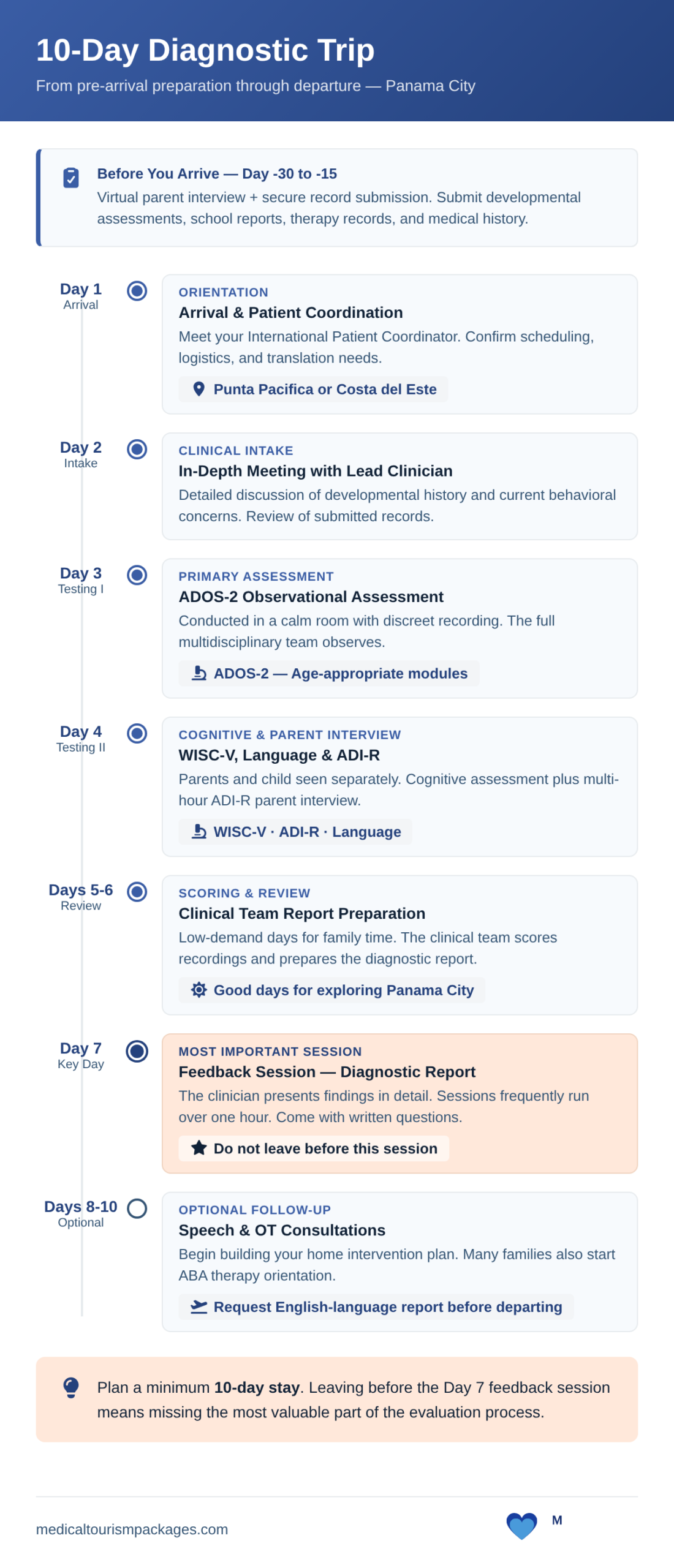
What Is the Day-by-Day Timeline of a Diagnostic Visit to Panama?
Plan for a minimum 10-day stay. The table below shows what to expect from arrival through departure.
Day Activity Notes for Medical Tourists Day -30 to -15 Virtual parent interview and secure submission of prior records Complete this before booking flights as it determines the evaluation structure Day 1 Arrival and orientation with the International Patient Office Coordinators handle scheduling, logistics, and translation needs Day 2 Clinical intake meeting with the lead clinician Expect an in-depth conversation about developmental history and current concerns Day 3 Testing Session I — ADOS-2 or primary observational assessment Conducted in a calm, child-optimized room with discreet recording for team review Day 4 Testing Session II — cognitive, language assessments, and ADI-R parent interview Parents and child are seen separately during this session Day 5–6 Scoring and clinical team review Low-demand days suitable for relaxed local time with the family Day 7 Feedback session with presentation of the diagnostic report Sessions frequently run over one hour — come with questions prepared Day 8–10 Optional follow-up with speech and occupational therapists Recommended before departure to begin building the home intervention plan
What Should Families Bring and Prepare Before Arriving in Panama?
Preparation before arrival directly affects the quality of the evaluation. Submit prior records through the clinic’s secure portal 15 to 30 days before arrival. These records help the team design the right assessment structure.
- Previous developmental assessments and evaluation reports
- School reports and Individualized Education Plans (IEPs)
- Therapy records from speech, occupational, or behavioral therapists
- Full pediatric medical history including vaccinations and medications
- Written summary of current behavioral concerns from parents and teachers
How Is a Panama Diagnosis Recognized Back in Your Home Country?
Panama’s clinics diagnose using DSM-5 criteria. This is the same standard used in the US, Canada, the UK, and most of Europe. A diagnosis from a licensed Clinical Neuropsychologist, Psychiatrist, or Neurologist is accepted by school systems and specialist referral pathways at home. A diagnosis from an unlicensed counselor or therapist may not be accepted. Before booking, confirm in writing that the final report will be provided in English. Leading clinics in Punta Pacifica and San Francisco provide bilingual reports as standard.
What Autism Treatments Are Available in Panama?
Panama’s role in autism care extends beyond diagnosis. For families seeking active intervention, Panama offers a full spectrum of treatment options. These range from established behavioral therapies to advanced biological protocols. The table below summarizes what is available.
Treatment Availability in Panama Evidence Status ABA Therapy Widely available through dedicated providers Established, extensively researched Stem Cell Therapy Available through regulated private clinics Emerging, early-phase trials ongoing Peptide Protocols Available through integrative and regenerative clinics Emerging, outcomes vary by protocol Fecal Microbiota Transplant (FMT) Available through integrative clinics Emerging, promising early evidence Wellness Programs Available alongside diagnostic and treatment protocols Supportive, adjunctive role
What Behavioral and Therapeutic Programs Does Panama Offer?
Applied Behavior Analysis (ABA) is the most widely researched intervention for ASD. It is available in Panama through dedicated providers including CASPAN and several specialized private clinics. ABA programs build communication, social, and adaptive skills through structured reinforcement strategies.
Alongside ABA, families can access speech therapy, occupational therapy, and developmental therapy. These are available through the same private clinic network used for diagnosis. Many facilities in Panama City offer follow-up consultations during the final days of the trip.
What Is Stem Cell Therapy for Autism and Is It Available in Panama?
Stem cell therapy is an emerging biological intervention available in Panama under regulated medical supervision. The most common protocol uses umbilical cord-derived mesenchymal stem cells. These cells aim to reduce neuroinflammation and support neural connectivity.
Several early-phase clinical trials have reported measurable improvements in communication and adaptive behavior. Larger randomized controlled trials are still ongoing. Families should treat this as an investigational therapy. Request full documentation of the protocol, the cell source, and the supervising clinician’s credentials before committing.
What Are Autism Peptide Therapies and Are They Offered in Panama?
Peptide therapies involve short chains of amino acids that influence neurological and immune function. Panama’s integrative clinics offer these as part of broader autism treatment programs. They are typically administered via subcutaneous injection or intranasal delivery.
- Cerebrolysin — Targets cognitive and language support
- Selank — Targets anxiety reduction and social adaptability
- Dihexa — Targets executive function
- BPC-157 — Targets mood regulation and gut-brain axis support
- Epithalon — Targets sleep dysregulation
Reported outcomes vary. Families should request peer-reviewed references for any protocol being proposed.
What Is Fecal Microbiota Transplant Therapy for Autism?
Fecal Microbiota Transplant (FMT) therapy targets the gut-brain axis. This is the bidirectional communication system between the gastrointestinal tract and the central nervous system. Research has found consistent microbiome differences in autistic individuals. Disruptions in gut bacteria are linked to gastrointestinal symptoms, mood dysregulation, and behavioral challenges common in ASD.
A landmark study published in Cell Host and Microbe reported lasting improvements in both gastrointestinal symptoms and core ASD behaviors at two-year follow-up. Panama’s integrative clinics offer FMT under medical supervision. Before proceeding, confirm that donor screening protocols meet international standards.
What Autism Wellness Programs Can Families Access in Panama?
Structured wellness programs run alongside medical protocols. They address broader physiological factors that influence ASD symptoms. These programs are most effective when discussed with the lead clinician at the start of the visit.
- Nutritional therapy — Targets metabolic and mitochondrial function
- Sensory integration therapy — Reduces hypersensitivity to environmental stimuli
- Mindfulness-based approaches — Supports both the individual and the family unit
- Naturopathic support — Uses functional medicine testing to identify underlying physiological contributors
How Much Does Autism Care in Panama Cost?
The full cost of an autism medical tourism trip to Panama covers four categories. Families from the US typically save 40–70% compared to domestic private rates.
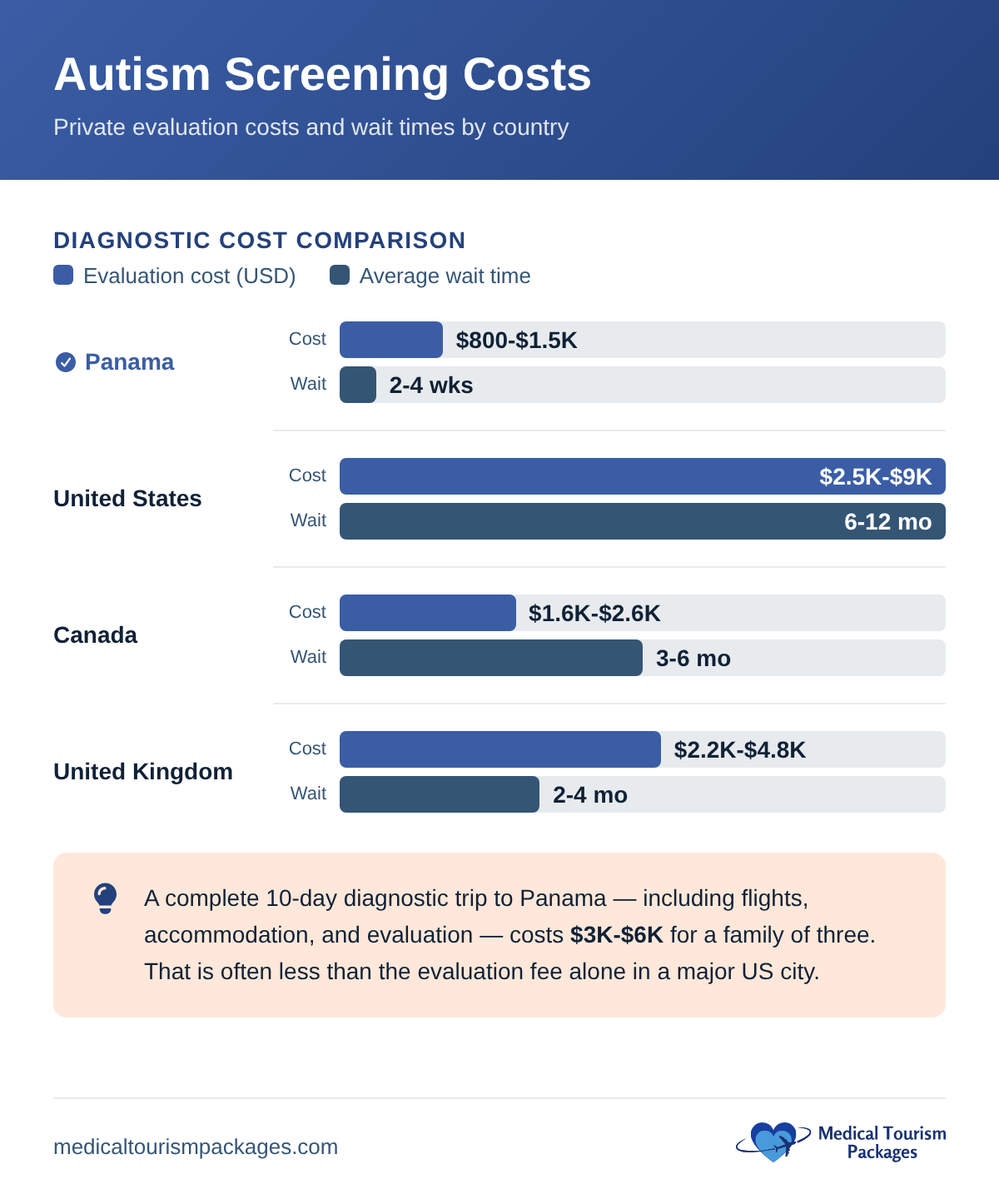
How Do Diagnostic Costs in Panama Compare to Other Countries?
Panama’s diagnostic costs are significantly lower than US and European private rates. The same DSM-5-based assessment battery costs a fraction of what families pay at home.
Country Private Cost (USD) Average Wait Time Panama $800 – $1,500 2 – 4 weeks United States $2,500 – $9,000 6 – 12 months Canada $1,600 – $2,600 3 – 6 months United Kingdom $2,200 – $4,800 2 – 4 months Mexico $700 – $1,200 2 – 4 weeks Colombia $600 – $1,100 2 – 3 weeks
What Is the Total Estimated Budget for an Autism Medical Tourism Trip?
A complete diagnostic trip for a family of three runs approximately $3,000 to $6,000 all-in. At the lower end, this is less than the diagnostic fee alone at a major US urban center. Here is a breakdown of typical costs.
- Diagnostic evaluation: $800 – $1,500 for a full assessment battery
- Round-trip airfare (per person): $300 – $600 from major US cities including Miami, Houston, Atlanta, and New York
- Accommodation (10 nights): $1,000 – $2,500 near the private clinic district in Punta Pacifica or San Francisco
- Meals, transport, and consultations: $500 – $1,000 for a family over 10 days
- Advanced treatments (if pursued): Varies by protocol — request itemized quotes from the treating facility
What Are the Logistics of Traveling to Panama for Autism Care?
Choosing the right neighborhood in Panama City makes a practical difference to the quality of the trip. The three areas most relevant to medical tourists each offer different advantages.
What Areas of Panama City Are Best Located Near Autism Clinics?
Three neighborhoods in Panama City serve medical tourists well. Each offers different benefits depending on the family’s needs.
Neighborhood Nearby Facilities Features for Families Punta Pacifica Hospital Punta Pacifica, The Panama Clinic High-end hotels, Multiplaza mall, walkable access to specialists Costa del Este Pacífica Salud branch Modern and pedestrian-friendly, parks, quieter low-stimulation environment San Francisco Clínica Hospital San Fernando Aparthotels with full kitchens, ideal for families managing restricted diets
For most medical tourists, Punta Pacifica is the default choice. It offers walkable proximity to the two most internationally prominent facilities. San Francisco suits families who need kitchen access and more space for an extended stay. Costa del Este is better for families who need a calm, quiet environment between clinic visits.
What Support Does Panama Offer Children with ASD During Their Visit?
Panama’s leading clinics have designed their physical environments with neurodivergent patients in mind. The Panama Clinic’s pediatric waiting areas use soft indirect lighting and interactive elements. These help keep children regulated before assessments. Diagnostic rooms used for ADOS-2 evaluations are spacious and carpeted. Discreet recording equipment allows the full multidisciplinary team to observe without crowding the room. This produces a more naturalistic and accurate result.
International Patient Coordinators at Pacífica Salud and San Fernando manage scheduling, record coordination, and translation. For a parent traveling alone with an autistic child, this is a functional necessity rather than an optional service.
How Do Families Ensure They Are Choosing a Quality Provider in Panama?
Accreditation is the most reliable quality signal for a medical tourist. It reflects independent external audit rather than self-reported standards. Three accreditations matter specifically for autism care in Panama.
Which Accreditations Should Families Look for in a Panama Clinic?
Three accreditations provide the strongest quality assurance for autism care in Panama City.
- Joint Commission International (JCI) — Held by Hospital Punta Pacifica and Clínica Hospital San Fernando. This guarantees that clinical outcomes and patient safety protocols meet the same benchmark required of top-tier US hospitals.
- TEMOS — Held by The Panama Clinic. This guarantees standards specific to international patient management and cross-border continuity of care.
- Johns Hopkins Medicine International Affiliation — Held by Hospital Punta Pacifica only. This is the only such affiliation in Central America. It guarantees access to Johns Hopkins clinical protocols and physician training frameworks.
What Questions Should Families Ask Before Booking?
Beyond facility accreditation, families need to vet the individual clinician and the specific process. These four questions matter most before booking.
- Is the facility JCI or TEMOS accredited? Confirm independently via public registries, not the clinic’s own website.
- Is the diagnosing clinician a licensed Clinical Neuropsychologist, Psychiatrist, or Neurologist?
- Will the final report be provided in English? Get this confirmed in writing before booking.
- Is a 10-day stay with a structured Day 7 feedback session built into the process? A clinic that skips this session removes the most valuable part of the process.
Is Autism Screening in Panama Right for Your Family?
Panama is not the right choice for every family. For those facing long domestic wait times, high private evaluation costs, or limited access to advanced treatments, it presents a genuinely compelling alternative. The diagnostic infrastructure is real and verifiable. JCI-accredited hospitals, DSM-5 protocols, gold-standard assessment tools, and internationally trained specialists in Panama City are facts families can confirm before booking.
A complete diagnostic trip typically costs less than the evaluation fee alone at a major US urban center. It happens in weeks rather than months. For families also pursuing advanced treatments, Panama is one of the few destinations where stem cell therapy, peptide protocols, FMT, and integrated wellness programs are available under regulated medical supervision. The families best served by Panama are those who prepare thoroughly, verify credentials independently, and arrive with a plan to continue intervention at home.
What Questions Do Medical Tourists Ask Most Often About Autism Screening in Panama?
You should plan for a minimum 10-day stay. Simple pre-screening visits may take 5–7 days. A complete evaluation with the Day 7 feedback session requires the full 10 days. Leaving before the feedback session means missing the most valuable part of the process. US, Canadian, and EU citizens can stay up to 90–180 days without a visa.
Yes, Panama has multiple JCI-accredited hospitals. Joint Commission International (JCI) is the same standard used by top US hospitals. Hospital Punta Pacifica and Clínica Hospital San Fernando both hold JCI accreditation. Hospital Punta Pacifica also holds an affiliation with Johns Hopkins Medicine International. The Panama Clinic holds TEMOS accreditation for international patient management. These hospitals meet the same patient safety standards as US medical centers.
Yes, most specialized ASD clinicians at Panama City’s JCI-accredited facilities are fluent in English. Many have completed training at North American or European institutions. International Patient Coordinators at facilities like Pacífica Salud and San Fernando provide additional translation support. Diagnostic reports are provided in both Spanish and English as standard at leading clinics.
Yes, a diagnosis from a licensed Clinical Neuropsychologist, Psychiatrist, or Neurologist using DSM-5 criteria is recognized in the US, Canada, and most of Europe. Panama’s private clinics use these same criteria and tools. School systems and specialist referral pathways accept DSM-5 diagnoses regardless of where they were issued. Request the final report in English before departure to avoid administrative delays at home.
Panama’s ASD specialists are board-certified professionals with extensive training. Clinical Neuropsychologists complete a medical degree followed by a specialized residency and postgraduate certification. Child and Adolescent Psychiatrists complete a medical degree plus a psychiatry residency with subspecialty training. Fellowship training often occurs at premier centers in the United States or top-tier Latin American institutions. Many specialists at JCI-accredited facilities have completed North American or European training programs.
Panama’s leading clinics work directly with your home country healthcare providers. The diagnostic report includes specific recommendations for follow-up therapy and intervention. Many clinics offer telemedicine follow-up appointments after you return home. The affiliation between Hospital Punta Pacifica and Johns Hopkins Medicine International creates pathways for high-level consultation in complex cases. Request contact details for the diagnosing clinician before departing Panama.
Medical Tourism Packages coordinates your entire autism evaluation journey in Panama. We connect you with certified specialists at JCI-accredited facilities in Panama City, arrange your travel and accommodations, and provide bilingual support throughout your visit. Get a free consultation to discuss your family’s needs and receive a personalized quote. Contact us today to start planning your autism screening trip to Panama.
How long should I stay in Panama for an autism evaluation?
Are Panama hospitals accredited to international standards?
Do Panama autism specialists speak English?
Will a Panama autism diagnosis be recognized in the US or Canada?
What training do Panama autism specialists have?
What happens if we need follow-up care after returning home?
Ready to Start Your Autism Screening Journey in Panama?