Book Appointment Now



ACL Surgery in Panama: Complete Guide, Costs, Recovery, and Top Hospitals
 By
By
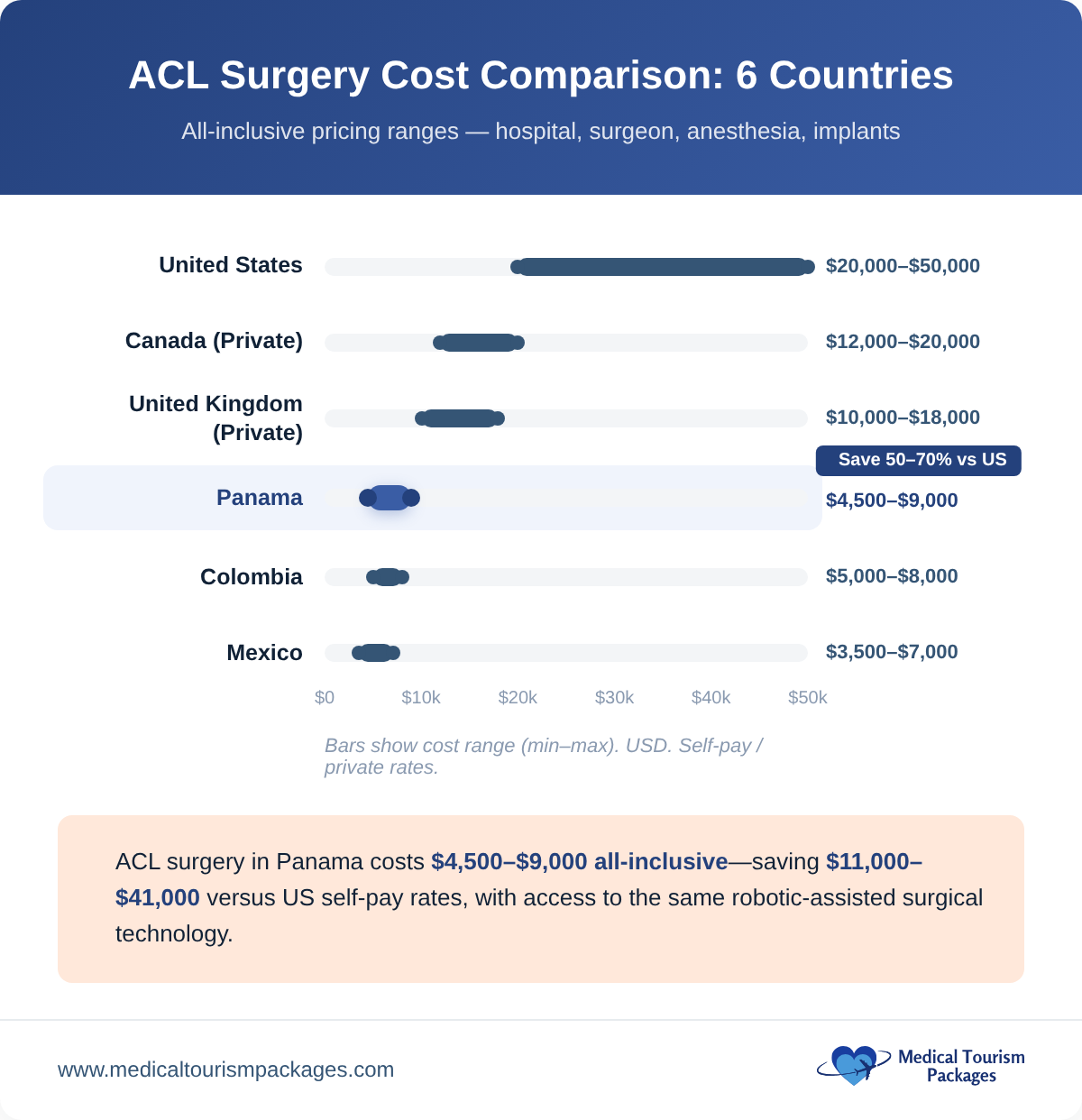
ACL surgery in Panama costs $4,500–$9,000 at JCI-accredited hospitals, saving you 50–70% versus US self-pay rates of $20,000–$50,000.
ACL reconstruction in Panama City ranges from $4,500 to $9,000 all-in, including surgeon, facility, anesthesia, and implants. Pacífica Salud and Clínica Hospital San Fernando hold JCI accreditation, with Johns Hopkins Medicine International affiliation at Pacífica Salud.
This guide covers costs, top hospitals in Panama City, surgeon credentials, procedure types, and recovery timelines. You will find cost comparisons, hospital profiles, and practical planning advice for your ACL surgery trip to Panama.
What Is ACL Surgery?
The anterior cruciate ligament (ACL) connects your thighbone to your shinbone. It controls rotational stability in the knee. ACL tears are among the most common serious sports injuries. They happen most often during pivoting, cutting, or sudden stops. When the ACL tears, the knee feels unstable or gives way. Surgery is recommended for active patients who want to return to sport or physical work.
ACL reconstruction replaces the torn ligament with a graft. The surgeon uses an arthroscopic technique with small incisions and a camera. Operating time is one to two hours. Your surgeon will choose the graft based on your age, activity level, and clinical history.
What Are the Main Types of ACL Reconstruction Grafts?
Each graft type has different strengths and trade-offs. Your surgeon will recommend the best option after reviewing your MRI and discussing your activity goals.
| Graft Type | Best Candidate | Key Advantage | Key Risk |
|---|---|---|---|
| Hamstring Autograft | Active patients, non-elite athletes | Smaller incisions, less anterior knee pain | Risk of hamstring weakness during sprinting |
| Patellar Tendon (BTB) Autograft | High-impact athletes returning to pivoting sports | Superior bone-to-bone healing, gold standard stability | Anterior knee pain at donor site |
| Allograft | Older patients, revision surgeries | No donor site, shorter surgery time | Slightly higher re-tear risk in younger athletes |
| InternalBrace / Primary Repair | ACL torn at the bone attachment | Preserves native ligament, less invasive | Only suitable for specific tear patterns |
How Much Does ACL Surgery Cost in Panama?
ACL surgery in Panama costs $4,500–$9,000 all-in. Uninsured US patients pay $20,000–$50,000 for the same procedure. The 50–70% saving applies to the same technology and FDA-approved implants. Panama’s lower costs are not a result of lower quality. Private hospitals in Panama City operate with less administrative overhead than US systems. They do not carry the complex insurance billing costs that drive up prices in North America. Panama prices ACL surgery as a single all-in fee. This covers the surgeon, facility, anesthesia, implants, and initial recovery. In the United States, each component arrives as a separate bill.
For a broader look at orthopedic procedures available in Panama, see our complete guide to orthopedic surgery in Panama.
How Does Each Cost Item Compare Between Panama and the US?
The savings apply to every cost item. The largest gaps are in facility fees, post-operative stays, and physical therapy. Physical therapy costs $40–$75 per session in Panama versus $75–$200 in the US. This makes it practical to complete early rehabilitation before returning home.
| Expense Category | Panama Estimated Cost (USD) | US Estimated Cost (USD) | Savings |
|---|---|---|---|
| Surgeon Fee | $1,200–$2,500 | $4,000–$10,000 | 60–75% |
| Facility and OR Fee | $1,000–$2,500 | $5,000–$15,000 | 75–83% |
| Anesthesia | $400–$800 | $1,000–$2,500 | 60–68% |
| Implants and Grafts | Included in package | $3,000–$6,000 | 100% |
| Post-Op Clinical Stay | $300–$800 | $5,000–$10,000 | 75–94% |
| Physical Therapy (Per Session) | $40–$75 | $75–$200 | 46–63% |
| Total All-In Estimate | $4,500–$9,000 | $20,000–$50,000 | 50–70% |
How Does Panama Compare to Other Medical Tourism Destinations on Price?
Panama also competes well against other medical tourism destinations. It costs significantly less than US or European private care. Prices are similar to Colombia, but Panama’s hospitals hold higher institutional accreditation than most lower-cost options.
| Country | Estimated Total Cost (USD) | Market Positioning |
|---|---|---|
| United States | $20,000–$50,000 | High-cost benchmark |
| Canada (Private) | $12,000–$20,000 | Avoidance of public waitlists |
| United Kingdom (Private) | $10,000–$18,000 | GBP-converted private rates |
| Panama | $4,500–$9,000 | High-tech, USD stability, JCI-accredited |
| Colombia | $5,000–$8,000 | High-volume orthopedic specialist market |
| Mexico | $3,500–$7,000 | Proximity and scale leader |
What Are the Best Hospitals for ACL Surgery in Panama?
Panama City’s top private hospitals are in three modern districts: Punta Pacifica, Paitilla, and Costa del Este. The key quality benchmark for medical tourists is Joint Commission International (JCI) accreditation. JCI is the same global standard used by top US and European hospitals. It requires facilities to meet over 1,000 safety standards for patient care, infection control, and medication management. Two of Panama’s three leading orthopedic hospitals hold active JCI accreditation. The third holds TEMOS accreditation, which evaluates the quality of international patient care.
Which Panama City Hospitals Perform ACL Reconstruction?
Three hospitals dominate orthopedic medical tourism in Panama City. Each offers a distinct combination of accreditation, technology, and international patient services.
| Hospital | Accreditation | Key Technology | International Services |
|---|---|---|---|
| Pacífica Salud – Hospital Punta Pacífica | JCI (since 2011), Johns Hopkins affiliation | Robotic surgery (Hugo Ras), smart OR with laminar flow | Dedicated International Patient Office, bilingual staff |
| The Panama Clinic | TEMOS | Institute of Robotic Surgery, 8th-floor rehab center | 6-language support, direct billing for US Veterans |
| Clínica Hospital San Fernando | JCI (since 2011) | Robotic-assisted orthopedics | Tulane Medical Center affiliation, 24-hour nursing |
Pacífica Salud – Hospital Punta Pacífica is the most advanced private hospital in Central America. Its Johns Hopkins Medicine International affiliation gives it direct access to US clinical protocols. It has held JCI accreditation since 2011. Smart operating rooms with laminar flow infection controls are a key feature.
The Panama Clinic was the first facility in Panama to receive TEMOS accreditation. It operates a dedicated Institute of Robotic Surgery and a comprehensive 8th-floor rehabilitation center. The multilingual international patient team covers six languages including English, French, Mandarin, and Portuguese. The clinic offers direct billing for US Veterans and Retirees.
Clínica Hospital San Fernando was the first hospital in Panama to receive JCI accreditation, also in 2011. It maintains affiliations with Tulane Medical Center and Baptist Health South Florida. Its orthopedic department performs thousands of joint procedures annually. It offers 24-hour nursing and private recovery rooms.
Read our complete guide for American medical tourists in Panama for detailed planning advice on travel, accommodation, and logistics.
How Do You Choose the Right Orthopedic Surgeon in Panama?
Choosing the right surgeon is the most important decision in your ACL reconstruction. Tunnel placement precision determines graft survival and long-term knee stability. A well-accredited hospital does not guarantee the surgeon has specialist ACL experience. Panama’s leading orthopedic surgeons are fellowship-trained and internationally credentialed. Most offer virtual consultations by video call so you can share your MRI before committing to travel.
What Credentials Should You Look for in a Panama ACL Surgeon?
When evaluating any surgeon, look for these credentials:
- Regulatory oversight: All surgeons in Panama are licensed by the Ministry of Health (MINSA). Verify credentials through the Panamanian Medical Association or the hospital’s directory.
- International membership: Leading Panama ACL surgeons typically hold membership in the American Academy of Orthopaedic Surgeons (AAOS) or equivalent bodies.
- Fellowship training: Look for a fellowship in sports medicine or knee surgery at a US, European, or Brazilian institution.
- Annual procedure volume: Ask how many ACL reconstructions the surgeon performs per year. Higher volume consistently links to better outcomes.
What Happens During ACL Surgery in Panama?
Panama’s top orthopedic centers perform ACL reconstruction through two to three small incisions. The surgeon inserts a fiber-optic camera to see the joint. The torn ACL remnants are removed. Bone tunnels are drilled in the tibia and femur. The graft is secured with screws or fixation devices. After testing knee stability and range of motion, the surgeon closes the incisions. Operating time is one to two hours. Most patients are discharged the same day or after one night of observation.
Which Panama Hospitals Offer Robotic-Assisted ACL Surgery?
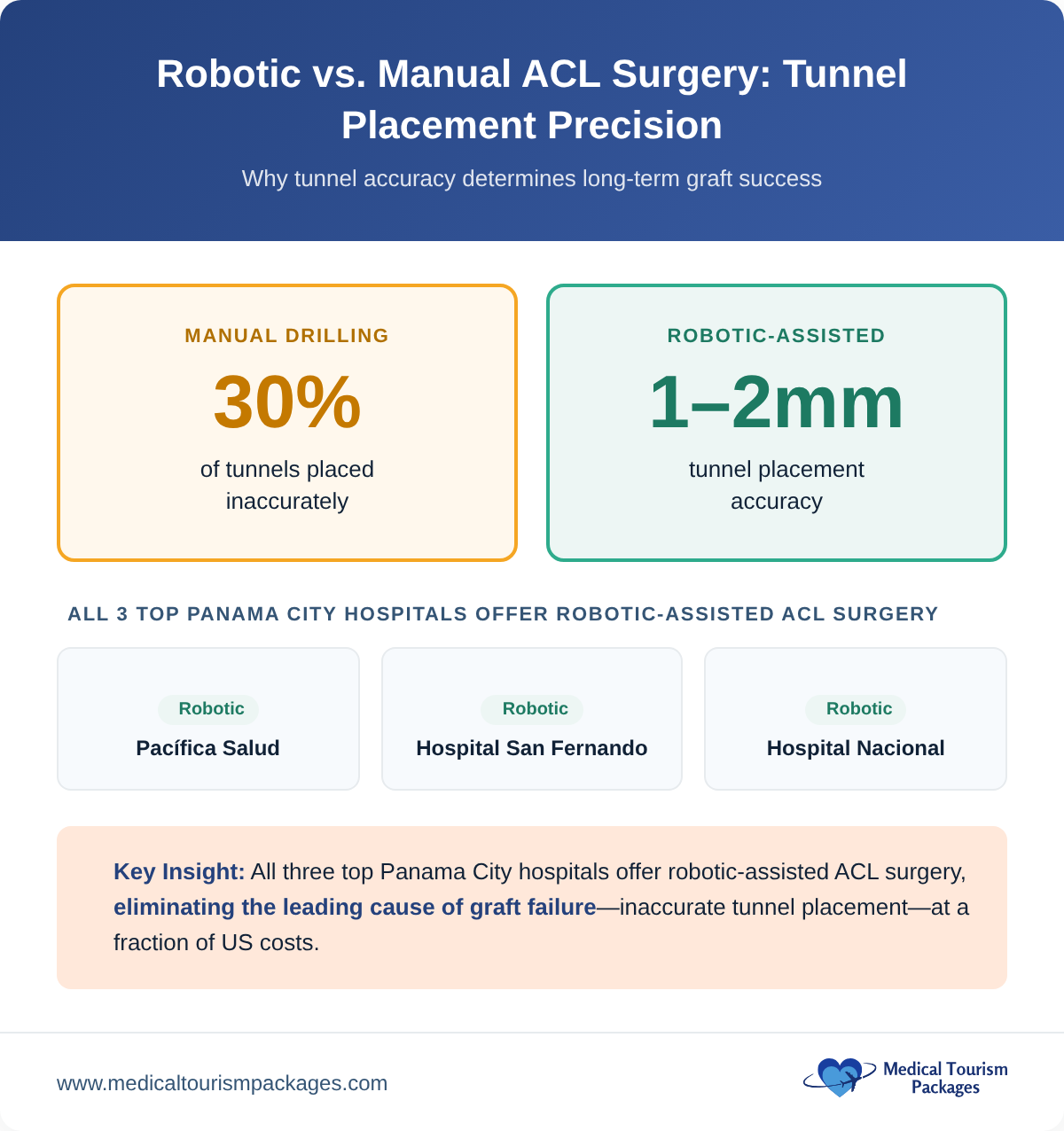
Before surgery, advanced imaging maps the best tunnel placement. Research shows that up to 25–30% of manually drilled tunnels are placed incorrectly. This is a leading cause of graft failure. Robotic assistance guides drilling to within one to two millimeters of the planned position. Panama is a regional leader in robotic orthopedic surgery. Three hospitals in Panama City offer robotic-assisted ACL surgery:
- Pacífica Salud — Hugo Ras robotic system, available in Punta Pacifica
- The Panama Clinic — dedicated Institute of Robotic Surgery
- Clínica Hospital San Fernando — robotic-assisted capability within its orthopedic department
Your surgeon will decide if robotic guidance is appropriate for your case.
What Is the Recovery Timeline for ACL Surgery in Panama?
Full recovery from ACL reconstruction takes 9 to 12 months. The biological process behind this timeline is called ligamentization. This is the gradual transformation of the graft into a functioning ligament through revascularization and tissue remodeling. This process cannot be rushed. Returning to sport too early is the primary cause of graft failure. Most patients walk independently within one to two weeks. Physical therapy begins on Day 3 after surgery.
What Are the Recovery Phases After ACL Surgery?
Recovery follows six structured phases. Progression is based on functional milestones, not just calendar time. The Phase III warning is especially important for medical tourists returning home mid-recovery.
| Phase | Timeline | Key Milestones and Goals |
|---|---|---|
| Phase I: Acute Recovery | Weeks 1–2 | Partial weight-bearing with crutches. PT begins Day 3. Target 0–90° flexion. Control swelling. Restore full extension. |
| Phase II: Early Mobility | Weeks 2–6 | Transition to full weight-bearing. Discard crutches by Week 4. Target 0–120° flexion. Restore normal gait mechanics. |
| Phase III: Build Stage | Months 2–4 | Stationary biking and light elliptical. Progressive resistance training. The graft is at its biological weakest during this phase due to active revascularization. Avoid high-impact loading. |
| Phase IV: Power Stage | Months 4–6 | Introduce jogging when quad strength reaches 70% of the opposite leg. Agility drills. Jumping and landing mechanics. |
| Phase V: Sport-Specific | Months 6–9 | Non-contact sports training. Sprinting. Sport-specific movement patterns without pain or instability. |
| Phase VI: Return to Sport | Months 9–12 | Functional return-to-sport testing including Biodex and hop tests. Full clearance for competitive pivoting sports. |
How Long Should a Medical Tourist Stay in Panama After ACL Surgery?
A minimum stay of 10 to 14 days in Panama City is recommended. This covers surgery, the highest-risk period for complications, and the first block of physical therapy. Do not fly home before receiving formal travel clearance from your surgeon.
| Stay Period | What Happens |
|---|---|
| Days 1–2: Pre-Operative | Final consultation, blood work, cardiology clearance, and pre-operative imaging review. |
| Day 3: Surgery | Procedure performed in the morning. Same-day discharge or one night of observation. |
| Days 4–12: Initial Recovery and PT | Wound monitoring, swelling management, and first five physical therapy sessions. Highest window for DVT and infection risk. |
| Days 13–14: Travel Clearance | Final surgical follow-up. Suture removal. Fit-to-fly clearance issued. Rehabilitation protocol provided for your home therapist. |
What Are the Risks of ACL Surgery in Panama?
ACL reconstruction is a well-established procedure. At JCI-accredited facilities in Panama, complication rates are comparable to leading North American hospitals. The most common post-operative complication is loss of motion from excessive scar tissue. This is largely preventable by following the physical therapy protocol started within 24 hours of surgery. Graft failure occurs in 5–8% of cases globally. It is most common in younger athletes who return to pivoting sports before the graft has fully matured. Panama’s JCI hospitals report nosocomial infection rates at the lower end of global benchmarks. This is due to laminar flow systems and positive and negative pressure operating rooms.
How Do Panama’s Hospital Safety Rates Compare to the US?
Panama’s JCI-accredited hospitals match US safety benchmarks across all key outcome metrics. Surgical success rates reach 95–97% at Panama’s top facilities, with infection rates below the US average.
| Outcome Metric | Panama JCI Facilities | US Benchmarks |
|---|---|---|
| Surgical Success Rate | 95–97% | 95–98% |
| Nosocomial Infection Rate | 0.5–1% | 1–2% |
| Average Revision Rate | 5–8% | 5–10% |
| Return-to-Sport at 9–12 Months | 85–90% | 80–90% |
For a side-by-side comparison of Panama with other Latin American destinations, read our Panama medical tourism review.
What Is the DVT Risk of Flying After ACL Reconstruction?
Medical tourists also face one travel-specific concern. Deep vein thrombosis (DVT) risk is higher when surgery is combined with a long-haul return flight. Panama’s standard 10 to 14 day stay aligns with the CDC’s recommendation to wait at least 10 days before flying. Your surgeon will prescribe anticoagulant medication such as Enoxaparin for the journey home. You should also wear graduated compression stockings, move your ankles regularly, walk the cabin when possible, and book an aisle seat.
What Are the Advantages of ACL Surgery in Panama?
Panama combines cost savings, institutional quality, and logistical convenience. These advantages are hard to match elsewhere in the region. The key advantages for medical tourists are:
- 50–70% cost savings compared to US self-pay rates, with savings remaining substantial even after flights and accommodation.
- USD economy, eliminating exchange rate risk entirely so you budget and pay in dollars from start to finish.
- JCI-accredited facilities with Pacífica Salud carrying a Johns Hopkins Medicine International affiliation giving access to US clinical protocols.
- Fellowship-trained surgeons who completed advanced training in North America and Europe, all regulated by MINSA.
- Robotic-assisted surgery via Hugo Ras, Mako, CORI, and ROSA platforms, improving tunnel placement accuracy and reducing graft failure risk.
- Outcomes comparable to US benchmarks, with surgical success rates of 95–97% and infection rates of 0.5–1% at JCI facilities.
- Visa-free entry for US, Canadian, and EU citizens for up to 180 days with no medical visa required.
- Short flight times from major US cities: Miami is three hours away, Atlanta and Houston are four hours, and New York is five to six hours.
- English-speaking staff and dedicated international patient offices at all three major hospitals.
- Telemedicine follow-up for up to 12 months post-surgery, with direct communication available between your Panama surgeon and home-based physical therapist.
What Are the Disadvantages of ACL Surgery in Panama?
No medical tourism destination is without trade-offs. Panama is no exception. Consider these challenges before committing:
- Minimum 10–14 day stay required. You cannot fly home immediately after surgery. The in-country window covers wound monitoring, suture removal, early physical therapy, and fit-to-fly clearance. Plan your work schedule around this before you travel.
- Cross-border continuity of care. After returning home, you coordinate rehabilitation between your Panama surgeon and a local physical therapist. Identify and brief a home-based therapist before you leave. Confirm your hospital will transfer surgical notes and a rehabilitation protocol at discharge.
- DVT risk on the return flight. You will need anticoagulant medication and compression stockings for the journey home. This is manageable but requires a prescription before departure.
- Psychological difficulty of recovering abroad. Patient forums identify the isolation of recovering far from home as the hardest part of medical tourism, not the surgery itself. Bringing a travel companion makes a significant difference.
- Unregulated stem cell clinics. Stem cell therapy is marketed in Panama as an alternative to ACL surgery for partial tears. No peer-reviewed longitudinal clinical trials support these claims. Some clinics offering it operate outside the regulatory framework that governs JCI-accredited hospitals. Verify accreditation status carefully before engaging with any such facility.
What Questions Do Medical Tourists Ask Most Often About ACL Surgery in Panama?
How long should I stay in Panama after ACL surgery?
You should stay 10 to 14 days in Panama City after ACL surgery. Days 1 and 2 cover pre-operative consultations and blood work. Surgery is on Day 3. Days 4 through 12 cover wound monitoring and your first five physical therapy sessions. Days 13 and 14 include your final follow-up, suture removal, and fit-to-fly clearance.
US, Canadian, and EU citizens do not need a visa for stays up to 180 days in Panama.
Are Panama hospitals accredited to international standards?
Yes, Panama has multiple JCI-accredited hospitals. Joint Commission International (JCI) is the same standard used by top US hospitals. Pacífica Salud and Clínica Hospital San Fernando both received JCI accreditation in 2011. The Panama Clinic holds TEMOS accreditation, which specifically evaluates international patient care quality.
Pacífica Salud also holds a Johns Hopkins Medicine International affiliation. This gives it direct access to US clinical protocols and specialist training.
Do Panama orthopedic surgeons speak English?
Yes, most specialized orthopedic surgeons at JCI-accredited facilities in Panama City are fluent in English. All three major hospitals have dedicated international patient offices with bilingual staff. The Panama Clinic supports six languages including English, French, Mandarin, and Portuguese.
Most surgeons also offer virtual consultations in English. You can share your MRI and discuss your surgical plan before traveling.
What happens if I have complications after returning home?
Panama’s leading orthopedic hospitals offer telemedicine follow-up for up to 12 months after surgery. Your Panama surgeon can communicate directly with your home-based physical therapist. At discharge, you receive a full rehabilitation protocol and surgical notes to share with your local care team.
Identify and brief a home-based physical therapist before you travel. This ensures you have a local point of contact for routine follow-up care after returning home.
Is it safe to fly home after ACL surgery in Panama?
Yes, it is safe to fly after the recommended waiting period. Surgeons recommend staying at least 10 to 14 days before flying home. This aligns with CDC guidance for orthopedic patients. You will receive a formal fit-to-fly clearance from your surgeon before departure.
For the return flight, your surgeon will prescribe anticoagulant medication such as Enoxaparin. Wear graduated compression stockings, move your ankles regularly, walk the cabin when possible, and book an aisle seat.
What training do Panama ACL surgeons have?
Panama ACL surgeons are board-certified orthopedic specialists with fellowship training in sports medicine and knee surgery. They complete a medical degree followed by an orthopedic residency. After residency, they pursue a fellowship specifically in sports medicine or knee surgery at institutions in North America, Europe, or Brazil.
Many hold membership in the American Academy of Orthopaedic Surgeons (AAOS). All surgeons are licensed and regulated by Panama’s Ministry of Health (MINSA). You can verify credentials through the Panamanian Medical Association or the hospital’s directory.
Is Panama the Right Choice for Your ACL Surgery?
Panama delivers the greatest value to uninsured or underinsured US patients facing $20,000–$50,000 in domestic costs. It also suits Canadian patients bypassing public waitlists that routinely run 12–24 months. East Coast US patients benefit from short flight times and a dollarized economy. Panama is less suited to patients who need surgery within days, cannot commit to a 10–14 day stay, or have a complex medical history needing close supervision from a domestic specialist.
The decision comes down to three questions. Can the cost saving justify the trip? Can you arrange reliable continuity of care on your return? Are you prepared to recover away from home? If all three are manageable, Panama offers a competitive alternative to domestic care, not just on price but on clinical quality.
What Questions Should You Ask Before Committing to ACL Surgery in Panama?
Before booking, ask every hospital and surgeon these questions. Request written answers where relevant:
- Is the facility JCI or TEMOS accredited? Request the accreditation certificate and verify it is current. Do not accept verbal confirmation alone.
- What are the surgeon’s credentials and fellowship training? Ask where the fellowship was completed, in what subspecialty, and how many ACL reconstructions the surgeon performs annually.
- What is included in the all-in price? Confirm the fee covers surgeon, anesthesia, facility, implants, post-op stay, and physical therapy sessions. Ask what triggers additional charges.
- Is telemedicine follow-up available after I return home? Confirm the duration. Ask if your surgical notes and rehabilitation protocol will be transferred to your home therapist.
- What implant brand is used and is it FDA-approved? Panama’s top hospitals use FDA-approved implants identical to those used in the United States. Confirm this in writing.
- What is the hospital’s nosocomial infection rate? JCI-accredited facilities track and report this data. A reputable hospital will share it without hesitation.
Ready to Start Your ACL Surgery Journey in Panama?
Medical Tourism Packages coordinates your entire ACL surgery journey in Panama. We connect you with JCI-accredited hospitals, arrange your travel and accommodations, and provide bilingual support throughout your treatment. Get a free consultation to discuss your knee health goals and receive a personalized quote.
Contact us today to start planning your affordable ACL surgery in Panama.